
The A to Z of the Energy Transition: Z is for Zero Emissions
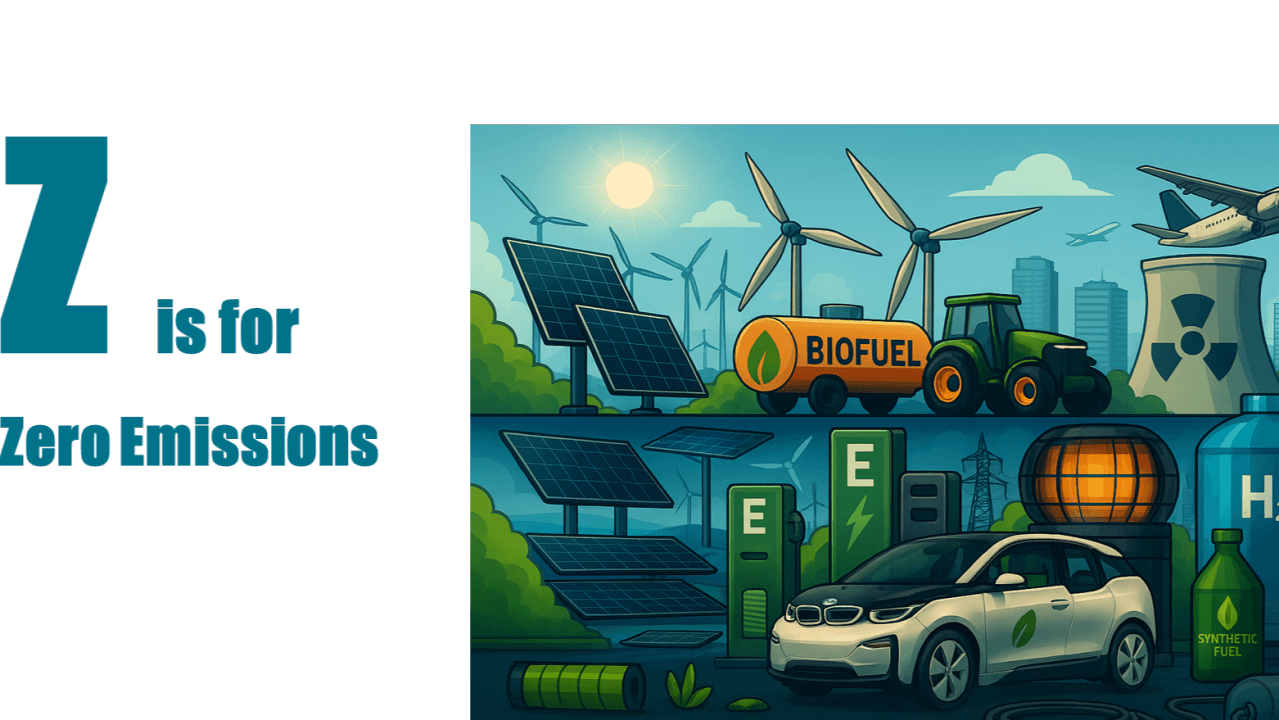
We've made it to Z!
I've been reflecting on this series on the back of the recent COP30 in Belém and the National Emergency Briefing in London last week, both of which provided a stark reminders of the need to act on climate change and what the energy transition is all in service of. So Z is all about zero emissions and, if you'll indulge me, provides a bit of a look back on the full A to Z.
It is now widely accepted that limiting the planet of 1.5 °C of warming is not going to happen. On current Nationally Determined Contributions (NDCs) we are on a trajectory to around 2.3 °C by around 2100. But that doesn't mean we should lose heart. Just a decade ago at COP15 in Paris the world was on track for around 3.6 °C and had we not made any progress global warming would be likely to have risen by 4-5 °C. According to the Energy Institute Statistical Review of World Energy since 2010 renewables and nuclear have avoided around 109 giga tonnes of energy-related emissions, that around 2.5 times the total emissions from energy in 2024. This is meaningful. We are making progress, just not fast enough.
The term 'Net Zero' has become polarised over the last year or so. For many it's a confusing term, with ambiguity on how it's measured. The 'net' clearly implies that some CO₂ emissions are set to remain, but with some form of negative emissions offsetting to reach a 'net' zero. Is it ok that I can offset the guilt from the emissions on a flight from London to New York for under £20? That's a relatively small price to pay on, say, a £300 one-way economy fare. The big question, which I don't think we've reached consensus on, is the nature of the negative emissions (genuinely captured CO₂ or merely avoided CO2) and its timeframe (immediate, such as DACC (direct air carbon capture) or decades in the case of a tree).
And even then it's not that simple. We need to look at the full system CO₂. For example, DACC uses HUGE amounts of zero-carbon electricity. In most situations that electricity would be far more effective used decarbonising the grid.
So what should we do?
A pathway towards zero emissions
To conclude this series I offer a few perspectives on how we might prioritise action and investment to get as close to zero emissions as possible.
1. Think merit order and don't let perfection get in the way of good!
In so many conversations about the energy transition I hear, "But what about <insert toughest use case for EVs / heat pumps / industrial heat>". These are all legitimate questions but each of them is focused on the most difficult to decarbonise use cases.
Let's start on the easy stuff! We can worry about the toughest challenges later.
In U is for the Unabatables (or hard to abate) I discussed the concept of thinking about the merit orders of both problems and solutions. The above example of DACC (Direct Air Carbon Capture) of where the merit order of the use of electrons is typically far better placed doing almost anything other than sucking carbon dioxide out of the atmosphere. Similarly, in H is for Hydrogen I described Michael Liebreich's hydrogen ladder, which gives a helpful view on where hydrogen is most (and least) valuable as a solution. Far better to use blue or green hydrogen to replace grey hydrogen on a refinery, than using it for heating or transportation. Used in the wrong application, green hydrogen actually slows the transition.
2. Electrification is a super power but we need to ensure the right electrons are in the right place at the right time
Electrification got more air time than any other topic and the reason for that is simple. It is a super power of the transition. In both P is for Primary Energy and E is for Energy Efficiency I talked about how electrification dramatically reduced the amount of energy we need for the same or better energy service (and if you're confused on the units of energy K is for Kilo Watts, Kilo Watt hours and other units of energy). It's important to recognise that today, electricity only represents around 20% of final energy use (on a primary-energy basis). Electricity is expected to make up 50%, or more, of final energy use by 2050.
Q to T was a mini-series covering transmission (T is for Transmission (& distribution), and grid queues (Q is Queues for the Grid), as well as the increasing role of storage (S is for Storage) including batteries and pumped hydro.
Perhaps I did renewables a disservice, by grouping them all under R is for Renewable Energy, but actually the story is fairly straightforward for wind and solar, which continue to beat virtually every forecast - in large part due to one country: China.
And whilst renewables may dominate, they're not the only show in town. Nuclear (N is for Nuclear Energy) is going through a renaissance at the moment, we'll have to see if we return to a 'golden age', and investment is scaling rapidly in advanced forms of geothermal (G is for Geothermal). I also enjoyed learning a lot more about fusion (F is for Fusion Energy) which has never looked as close to reality as it does today, but still faces many hurdles before it is technically and commercially viable at scale.
Special guest writer Rachel Bravard did a great job describing the role of investment, infrastructure and insurance (I is for Investment, Infrastructure and Insurance) across all of these transition technologies (which are now seeing in the order of $2 trillion per year invested). And in L is for Lithium and Other Critical Minerals I reminded readers of some of the challenges facing the energy transition in accessing the critical minerals required.
3. Don't forget the molecules - oil and gas will continue play a vital role but we need to decarbonise as much as possible
Whichever forecast you look at, there continues to be a role for oil and gas (O is for Oil and Gas) in energy, certainly until 2050 and I'm fairly confident we'll be producing some still in 2100, even if just for petrochemicals. Therefore, it is essential we do everything we can to reduce the emissions from the production, transportation and use of oil and gas.
Special guest writer Yvette Manolas covered the importance of tackling methane emissions (M is for Methane Emissions); the increasing role of carbon capture was covered under C is for Carbon Capture.
Of course not all energy molecules need to come from oil and gas and I explored the role of biofuels under B is for Bioenergy, already a fairly material part of the energy mix. I also covered creation of synthetic fuels through the AI-written X is for (Power) to X, which did portray quite a niche role for any use of electrons to create e-fuels and other synthetic solutions. (As an aside, it was perhaps reassuring to see that the AI-generated article was one of the least read, thus far, providing some hope that the power of human writing still matters).
4. Put consumers and people at the heart of a just transition
Finally and I think MOST IMPORTANTLY, it's time to put people at the centre of energy.
Many of us in the energy sector have come from the side that produces and transports stuff - oil, gas, electrons - without really thinking about the customer at the other end. The energy transition is going to force the energy sector to finally put consumers at its heart. This includes helping consumers make far more informed choices about the most efficient ways to live their lives. In E is for Energy Efficiency I described a range of ways in which to think about energy efficiency, including reductions in energy from using heat pumps (A is for Air source heat pump) and EVs (V is for Vehicles (electric ones!)). I also described the increasing role digital technologies (D is for Digitalisation) are playing across the energy system to drive efficiency and balance grids.
But the transition goes well beyond just those who consume energy. In J is for Just Transition I described the impacts on communities, impacted as traditional parts of the energy sector decline. Unfortunately, since writing that piece, the plight of Aberdeen has worsened with more jobs lost and companies failing. And ensuring we have the right workforce to deliver the transition was covered across J is for Just Transition, W is for Workforce and by special guest writer, Marta Zambujal de Oliveira, in Y is for Young Energy Leaders.
Let's work harder to make sure we engage everyone in the energy transition.
Conclusion and acknowledgments
That draws to a conclusion The A to Z of the Energy Transition.
A HUGE thank you to everyone who has engaged in this. I've really enjoyed reading your comments and questions. There is a small group that has engaged regularly across the series (you know who you are!), for which I'm particularly grateful.
A special thank you to the three special guest writers: Rachel Bravard, Yvette Manolas and Marta Zambujal de Oliveira; as well as Gemma Fox for the contribution on G is for Geothermal.
And I'm very grateful for the continual support and editorial wisdom of Will Dalrymple MEI, Senior Editor of the Energy Institute's New Energy World. A full A to Z is planned in an accessible format (watch this space)!
That's it for now. Thank you again for reading, especially those of you who made it this far!
Further reading
Here's the final set of links, from Will Dalrymple MEI and the Energy Institute New Energy World magazine.
News
NESO’s 25-year view maps potential UK energy transitions to net zero
Former UK Prime Minister Tony Blair calls for reset on net zero strategies and climate politics
Comment
Moving towards net zero in a complex and uncertain environment
Ten years on from the Paris Agreement – a decade that defied predictions
Beyond targets: why the UK energy transition needs a new story
Features
Energy Policy Debate on future of gas focuses on current need, despite renewables growth
What’s the latest outlook for the energy transition? BP and DNV forecasts compared
