
The A to Z of the Energy Transition: T is for Transmission (& distribution)
"There's no transition without transmission."
I am not sure who to attribute that statement to (please comment if you know), but I like it!
As I covered in Q is Queues for the Grid, the build out of grid to connect new renewable projects, as well as increasing demand for cooling and data centres, is a critical enabler to the transition. In this edition, as well as transmission, I'll also cover the distribution system, and the increasing role of country-to-country interconnectors (including some pretty audacious projects).
I've always found the analogy of thinking of the electrical system as a road network a helpful one. Just as the role of the road network is to move vehicles efficiently from one place to another, the electrical grid needs to move electrons efficiently to arrive in the right place at the right time. As I covered in the previous edition, S is for Storage, there are limited (albeit rapidly increasing) means of storing electricity, so the vast majority of electrons (or more specifically their electrical signal) arrive at their end use within around one milliseconds of generation (assuming the source of generation was around 200 km away). Think about it, in the time it takes to read this sentence, an electrical signal could have circumnavigated the world 15 times! And just as there is congestion on roads, there is often congestion and capacity bottle necks on electrical grids. Most large generation sites (be they offshore wind, nuclear or gas plants) are typically, for obvious reasons, not located near cities and other major demand centres. So let's explore the different parts of the electrical grid, the growth required for the energy transition and how digital technologies are playing an increasingly important role.
Transmission: The motorways of electricity
Transmission lines are the motorways (or interstates) of the power system. They carry huge 'volumes' of electricity at very high voltages (typically 132 kV to 400 kV in the UK) over long distances, from power stations or large renewable projects to regional substations. Just as motorways connect major cities with minimal stops and high speed, transmission networks connect generation hubs to demand centres with minimal losses. They are designed for efficiency and capacity, not local access. The high voltage element is critical to reduce losses (from your high school physics Ohm's law defines resistive electrical losses as proportion to the current squared, so to minimise losses the voltage is stepped and current reduced proportionally). The high voltages necessitate that the cables are suspended high above the ground on the large pylons that are often seem snaking across the countryside.
Globally, the International Energy Agency (IEA) estimates that annual investment in electricity grids needs to exceed $600 billion by 2030, nearly doubling current levels of around $300 billion. This scale reflects the challenge: grids must accommodate renewable generation, electrification of transport and heating, and cross-border energy flows. Depending how you measure it, the global grid would stretch out to between 70-100 million km. By 2050 this is expected to roughly double to 166 million km (according to the International Energy Agency (IEA)) or 205 million km according to DNV - for reference the sun is around 150 million km away!
National Energy System Operator, which was recently separated and brought into public ownership, operates this backbone across GB (I deliberating say GB, rather than UK, as Northern Ireland is integrated with the Irish grid). Alongside National Grid, which owns the transmission infrastructure in England and Wales, and SSEN Transmission in Scotland, vast investment of over £30bn is expected out to 2030 as part of the 'Great grid upgrade'. This is expected to great at least 55,000 new jobs. Such is the scale of this project that for the first time (I think), National Grid has recently been running TV adverts to raise public awareness. https://youtu.be/nTnbumNAL2E
The need for public awareness raises the question on how society accepts the need for more transmission. Very few people want a view of a pylon in their back yard. National Grid has been working on some innovative designs of pylons. In 2023 the first T-pylons were put into operation between Bridgwater and Loxton in Somerset, England, to connect with Hinckley Point (a major nuclear project). The T-pylons are around a third shorter than conventional pylons.
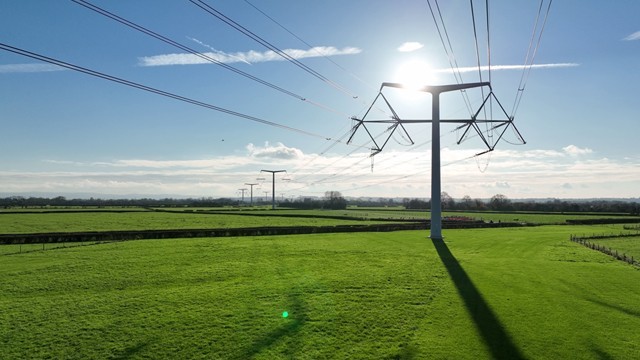
Image of T-pylons: Source: National Grid website
Digital technologies also have an important role to play in optimising transmission and reducing the need for infrastructure. Dynamic line ratings can be applied to some transmission lines, as maximum capacity is varied according to weather conditions (wind and cooler weather allows more power to flow). Digital twins are also helping to optimise grid design and operation. I once heard a large US digital company claim to have a much better understanding of the US grid than any utility, having mapped every transmission and distribution line using satellite imagery.
Distribution: The B-Roads and neighbour streets
Once electricity reaches regional substations, it needs to get to homes, businesses, and factories. This is where distribution networks step in. These operate at much lower voltages (33 kV down to 230 V) and branch out extensively, delivering power to every socket. Like B-roads, they handle smaller volumes, more frequent stops, and local demand patterns. In the UK these are typically referred to as Distribution Network Operators (DNOs) - other countries use terms such as DSO (Distributed System Operator), LDC (Local Distribution Companies) etc. It's also worth noting that in many countries, such as France, and parts of the US there is not a distinction between transmission operators and distribution operators - for example Pacific Gas and Electric Company operates both electricity and gas, transmission and distribution across most of California. The GB grid has 23 DNOs, which are privately held firms (many of which are subsidiaries of larger players such as National Grid and SSE plc).
A similar model operates with the UK's gas grid, with National Gas operating the high pressure national transmission backbone and distribution companies such as Cadent Gas Limited operating distribution networks.
DNOs are at the forefront of enabling the energy transition, and their role is evolving rapidly as electricity demand rises and consumption patterns change due to electric vehicles, heat pumps, and decentralised generation. Traditionally, distribution networks were passive, designed for one-way power flows from transmission to consumers. Today, DNOs are transforming into active system managers, using technologies to boost capacity and flexibility without relying solely on costly physical upgrades such as new substations, as well as handling two-way flows from prosumers exporting from rooftop solar and home batteries.
Smart grid technology uses sensors, automation, and real-time data analytics to monitor network conditions and optimise power flows. DNOs can dynamically adjust voltage and load, allowing more renewable generation to connect without breaching capacity limit, helping to reduce curtailment and optimise existing infrastructure.
As I covered under D is for Digitalisation flexibility services are another key tool. Platforms like Sitigrid (full disclosure, I am an investor) are using digital technologies to help energy commercial consumers and energy producers optimise at a local level. In the domestic market, time of use tariffs such as Octopus Energy's agile tariff allow households to reduce electricity costs by shifting their consumption to lower demand period, such as overnight.
HVDC Interconnectors: International Motorways
High Voltage Direct Current (HVDC) interconnectors are like international motorways or high-speed tunnels linking countries. They allow significant bi-direction power transfer across borders – for example, between the UK and France or Norway – often under the sea. HVDC is chosen for these routes because it’s more efficient over very long distances and underwater, reducing losses compared to AC transmission. These interconnectors enable energy trading, balancing supply and demand, and integrating renewables across Europe. However, there are increasing political pressures in some countries, such as Norway, to limit exports to neighbouring countries as domestic power prices have increased.
Key UK interconnectors include:
• IFA and IFA2: Connecting the UK to France, providing largely French nuclear power to the UK with UK offshore wind exported to France.
• BritNed: Linking the UK and the Netherlands, supporting market flexibility.
• Nemo Link: Connecting to Belgium, enhancing grid stability.
• North Sea Link: The world’s longest subsea interconnector, linking the UK to Norway’s hydropower.
• ElecLink: Running through the Channel Tunnel to France.
• Viking Link: Connecting to Denmark, which came online in 2023
These interconnectors allow the UK to import surplus renewable energy when domestic generation is low and export excess wind power during high output periods. They also reduce reliance on fossil fuels and help maintain grid resilience during peak demand.
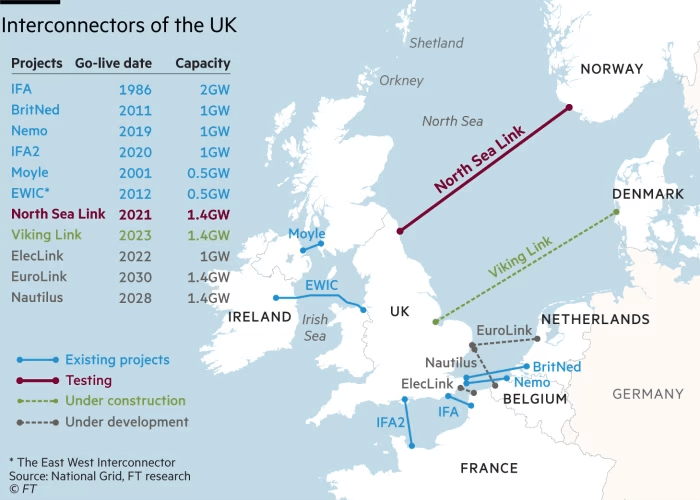
UK interconnectors (note ElecLink came online in 2022 and Viking Line in 2023) - Source: FT
High Voltage Direct Current (HVDC) technology is also triggering more ambitious projects to move renewable energy across vast distances, linking regions and even continents. Xlinks had planned to bring solar and wind power (with battery storage) all the way from Morocco to the UK via four 3,800 km subsea HVDC cables. The UK Government decided not to proceed with this project back in June and the company is now seeking other potential destinations for the power. Miliband shuns £25bn UK-Morocco renewable energy project Xlinks. Money News, Sky News.
There are even more ambitious projects seeking to connect Australia with Singapore on a 3.2 GW 4200 km (Suncable) and from North America to Western Europe via Eastern Canada and UK & Ireland through a 6GW HVDC 4000 km set of subsea cables (NATO-L) (both Redefining Energy's presenters, Laurent Segalen and Gerard Reid are co-founders of this project). Whilst north-south projects help shift abundant solar resource in one region to a less abundant region, an east-west project like NATO-L can help balance supply and demand across time zones. Overnight spare capacity in North America helps power the morning peak in Europe and conversely overnight offshore wind in Scotland could power the New York evening peak.
Again, new technology continues to play an important role in unlocking such projects. One of the big differences with HVDC, vs conventional transmission, is the need to convert AC (alternating current) to DC (direct current). Transforming up and down the voltage of DC is also far more complex than AC, so the role of smarter and more efficient invertor and transformer technologies are important. There may also be potential for super-conducting materials to improve efficiency of HDVC projects, particularly over very long distances where losses become more significant. There is also research into using lasers to transmit energy (see article below) and companies such as Space Solar looking to beam solar energy from space back to Earth via microwaves. I don't see such technologies ever replacing physical cables, but they certainly could add greater flexibility and resilience into the system.
In the current geopolitical context, long-distance interconnectors may be facing more challenges but in the long term it seems to me that they could be a critical tool in enabling the transition and ultimately providing more, not less energy security.
Just like the road network, having multiple options on routes, provides flexibility, increase reliability and decrease congestion.
The electrical grid is going to be a key enabler of the energy transition. Without more investment, technology and innovation we simply won't be able to connect more sources of low-carbon electricity to increasing demand centres. So the statement "There's no transition without transmission", really does ring true.
Further reading
Some further links from the Energy Institute's New Energy World magazine, via Senior Editor Will Dalrymple
News
Kilometre-long laser beam achieves highest-ever power transfer efficiency
Spanish blackouts won’t happen in the UK, says grid operator
UK government rules out move to zonal pricing for electricity market
Second Scotland-England subsea interconnector is approved
Features
Power to the people – the UK’s evolving electricity transmission system
How to avoid future black-outs: UK and Texas grid operators compare and contrast
HVDC – life after due diligence and the case for standardisation
Overcoming renewable energy variability for a stable grid
Comment
Responsible grid management could unlock UK renewable energy potential
The urgent need to expand the UK’s energy grid for net zero
Interconnectors
World’s longest land and subsea interconnector switched on
UK government abandons Moroccan HVDC megaproject plan
Cross-border energy networks could cut $800bn from ASEAN’s decarbonisation costs
Tasmania interconnector to boost Australia’s renewable grid
Online Resource details
Websites:
Link to LinkedIn post
Keywords: A-Z energy transition
Subjects: Transmission and distribution
