
The A to Z of the Energy Transition: V is for Vehicles (electric ones!)
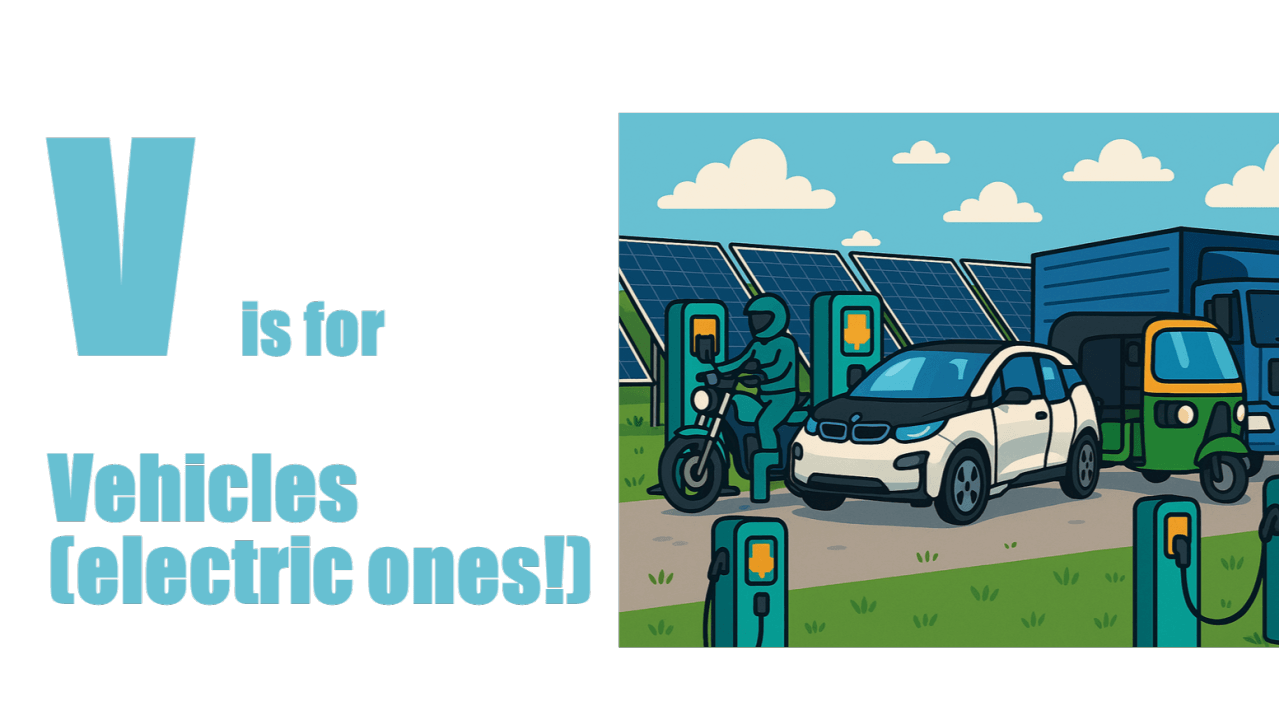
In this edition I describe the massive role electric vehicles (EVs) are playing in the energy transition. I've deliberately kept the focus on cars,
I'll describe three key aspects in which electric vehicles are a key driver of the energy transition - perhaps only second in importance to renewable generation:
• EVs as a massive driver of energy efficiency
• EVs as a significant flex and storage asset
• EVs as drivers of new business models (most of which we haven't invented yet)
But first a few facts and figures. Electric cars are not new. In fact EVs preceded ICE (internal combustion engine) cars in the 1800s. Scotsman (is there anything not invented in Scotland?!) Robert Anderson created the first (non-rechargeable) electric car in 1830, but it wasn't until the 1880s they entered regular service. Electric cars outnumbered combustion equivalents until the early 1900s. For the last century ICEs have clearly dominated ground transportation. It's surprisingly hard to get accurate data on the number of cars, motorbikes and trucks on the road around the world. In large part because scrappage and second-hand cross border sales are hard to track. Most sources indicate around 1.5 bn cars, around 1 bn motorbikes, plus tens of million three wheelers and a couple of hundred million trucks of various sizes. All in, that's somewhere between 2.5 -3 bn vehicles!
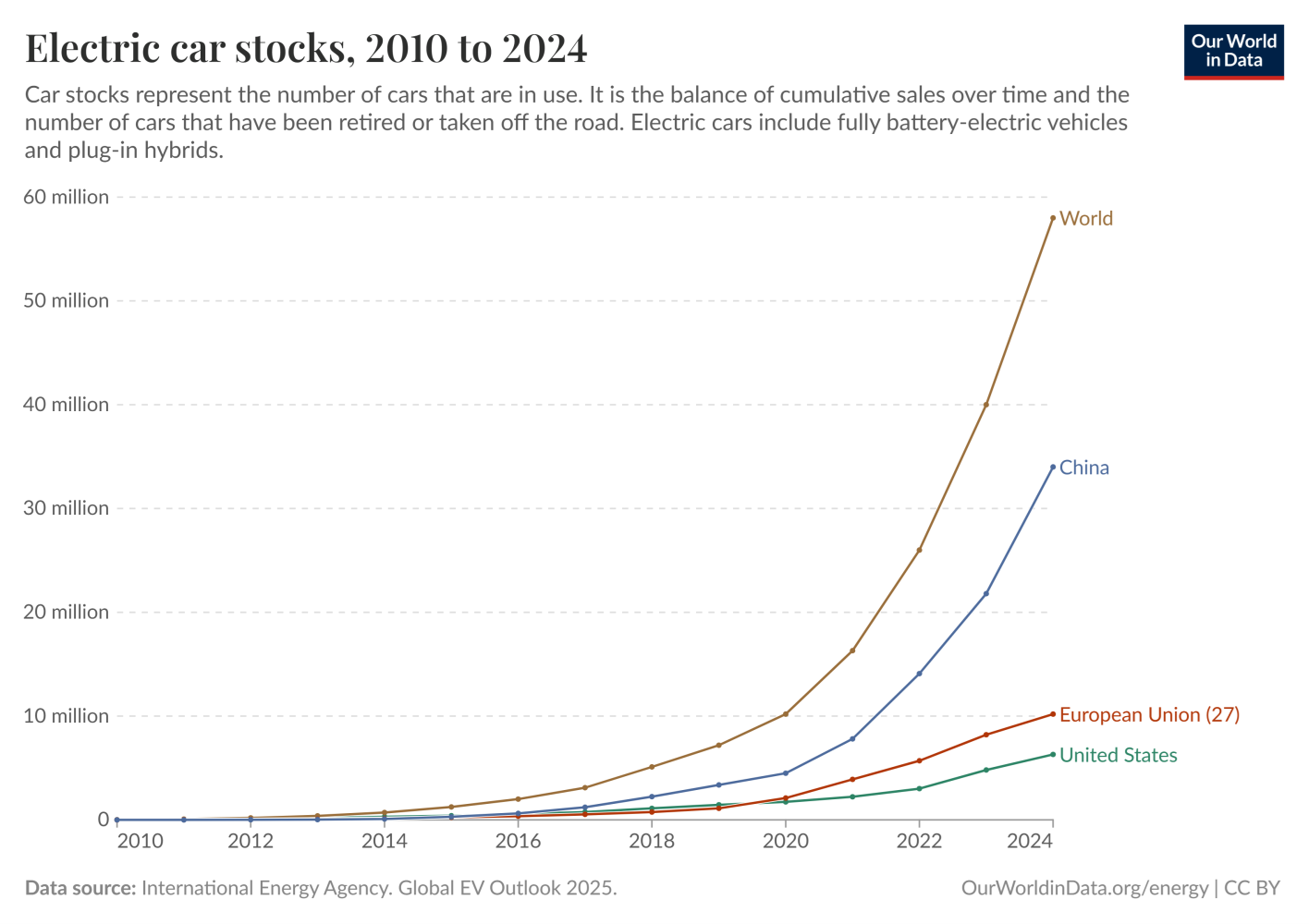
EVs are easier to track, because growth has been so recent. According to the chart below, from Our World in Data and International Energy Agency (IEA), there were nearly 60 million EV cars at the end of 2024. A further 20 million EV sales are expected this year (representing over 20% of new car sales). And, as the chart below shows, China is absolutely dominating this sector - both in terms of purchases but also production of new EV cars.
Sales of EV motorbikes and three wheelers are also growing rapidly, particularly in China and India. Heavy-duty trucks have taken longer to gain momentum but it's beginning to happen, once again with China leading but also increased electrification of trucking happening in Europe.
What about hydrogen? I'm not going to get into a big debate in this article, other than to say that the race on cars has already been won by EVs (global sales of hydrogen fuel cell cars are falling, with just over 4000 sold in the first half of 2025 - that's 4000 vs around 10 million EVs). And whilst there is still investment in hydrogen fuel trucks, I am happy to wager a bottle of your favourite tipple that hydrogen in all forms of ground transport will, at most, only be very niche.
EVs as a massive driver of energy efficiency
So why are EVs growing so rapidly ?
Globally, according to the Energy Institute Statistical Review of World Energy, the world consumed around 25 million barrels per day of petrol (gasoline) and 30 millions per day of diesel / gas oil, representing around half of total crude oil consumption. The vast majority of this found its way into ground transport (motorbikes, cars, trucks and some trains). In total, ground transport is responsible for around 20% of overall primary energy use. Only industry and buildings consume more energy by category.
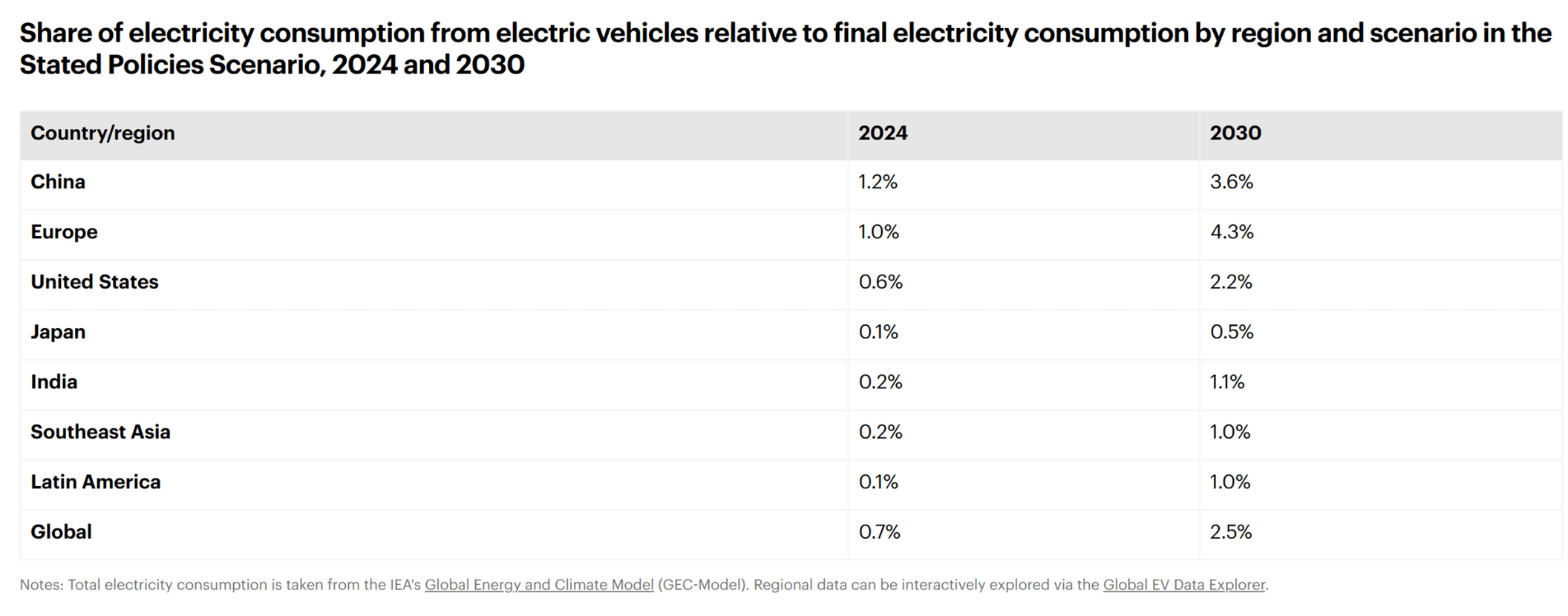
In E is for Energy Efficiency and P is for Primary Energy I described the huge efficiencies delivered by electrification of end use. And there a few places this plays out more than in vehicles, at least on land. An EV converts around 80-90% of its energy input into forward motion, compared to a petrol or diesel car at around 25-30%. Put differently, a petrol or diesel car needs about 3-4 units of energy for the same work as 1 unit of energy in an EV. This is a MASSIVE driver of efficiency. And despite the fact that EVs still represent less than 5% of all vehicles on the road, it is already eating into oil demand. According to the International Energy Agency (IEA) global oil demand was reduced by around 1.3 million barrels per day (over 1%) and by 2030 this figure could reach 5 million barrels per day.
But wait a minute, don't all those EVs consume a load of electricity? And if that electricity is generated by coal or gas, isn't this just shifting emissions from the car to generation. With some help from Microsoft Copilot, the grid carbon intensity needs to be around 800 gCO2/kWh before an EV emits as much as a ICE car. Even on a full lifecycle basis, reflecting the additional embedded CO2 from the manufacture of an EV this figure only drops to around 700 gCO2/kWh. To put that in the context the global average grid intensity in 2024 was around 445 gCO2/kWh. The UK was just 124 gCO2/kWh. And even China, which relies 60% on coal is around 560 gCO2/kWH (and falling fast).
So in short, there are very few countries where EVs emit more CO2 than ICEs, even on a full lifecycle basis. And before you accuse me of not covering the sustainability or ethical aspects, we clearly cannot ignore that there are of course human, societal and environmental challenges created by the insatiable demand for the materials that go into batteries. This is something I covered in L is for Lithium and Other Critical Minerals.
Expected increases in final electricity demand from EVs - Source: IEA
EVs as a significant flex and storage asset
In S is for Storage I discussed the significant role of different forms of storage on the energy transition and promised to come back to it in this edition. Whilst the growth of stationary batteries is dramatic, even more impressive is the growth of batteries which happen to be on wheels. In fact about 85% of total battery storage is in EVs.
EV aggregation is emerging as a powerful tool to support grid flexibility, to help shift load and provide services that support resilience. By coordinating the charging and discharging of thousands of EVs through digital platforms or aggregators, these vehicles can act as a distributed energy resource. At its simplest, just the ability to pause or delay charging significant numbers of EVs can help reduce demand. Many energy suppliers, including Octopus Energy, Fuse Energy, OVO, offer special EV tariffs which offer discounted rates in return for charging overnight or under the control of the supplier - typically at a third to a half of the standard tariff. Kraken (the technology platform behind Octopus Energy) claim to have 270,000 controllable devices connected to their Residential Flex, giving them 'control' over 1.7 GW of assets - to put that into context, that's equivalent to a large offshore wind farm or one of the two units at Hinckley Point C nuclear plant.
Most suppliers just control the charging of cars but taken this to the next level V2G (Vehicle to Grid) allows EVs to put electricity back into the grid. Suddenly at points of peak demand, thousands of cars can be used as a giant battery to act as a power station. And in some respects, better than a power station because the power is distributed across the DNO, without needing to go into transmission (see the previous edition T is for Transmission (& distribution)).
At the moment, very few cars offer V2G capability. Some, including Kia UK Limited and Ford Motor Company offer a mains outlet, which can power tools or parts of a home during a power cut, but this is not the same as bi-directional charging with the ability to feed directly into the grid.
For example, in the UK a few years ago, the Sciurus Project - Domestic V2G Demonstration aggregated over 300 residential vehicle-to-grid (V2G) chargers, allowing EVs to export electricity back to the grid during peak demand periods. This not only helped balance supply and demand but also provided financial incentives to EV owners. The benefits of EV aggregation extend beyond grid stability. It supports the integration of renewable energy by absorbing excess generation during low-demand periods and discharging during peaks.
However, none of this comes without risks and challenges, including cyber risk, the potential accelerated degradation of batteries, consumer engagement and, of course, creating the right regulatory frameworks. However, I am in little doubt that aggregation and V2G will become critical enablers in balancing grids around the world - and I'm sure some of the smartest minds on the planet are on the case in creating the solutions.
EVs as drivers of new business models (most of which we haven't invented yet)
Finally, and perhaps a little more abstract, is what new business models may emerge from the proliferation of EVs, particularly when other technologies converge.
For example, autonomous vehicles (which have long been five years away, may actually finally be five years away). Whilst of course an ICE could be made autonomous, it's going to be fleets of autonomous EVs which will dominate. This opens whole new businesses in Mobility-as-a-Service (MaaS). With autonomous fleets operating 24/7, and a range of ride-hailing and car-sharing models, integrated with mass transportation - car ownership may become a thing of the past. Just yesterday, Waymo announced its plans to launch autonomous taxis in London next year: Hello London! Your Waymo ride is arriving
Similarly, once sufficient cars are controlled autonomously does that change the manner and capacity in which roads are used? Vehicles can be maintained at uniform distances and speeds, optimally distributed across the road network (in very much a similar way to how I described grid optimisation in T is for Transmission (& distribution)). Will this mean the end to traffic jams and the utopia of every red light turning to green just in time? Probably not, as inevitably demand increases to match the supply but it's easy to see a world where car and road utilisation is an order of magnitude higher than today. There are also big efficiency gains to be had, with fewer stop starts and the aerodynamics of being able to run multiple vehicles in close convoy, just like racing cyclists. And of course seamless integration with public transport, bike schemes and safe pick-up and drop-off points will all be part of the solution.
In countries like India, battery swap has already become a major business for two and three wheelers. India has set a target of 26,000 battery swap locations by 2026 and 110,000 by 2030. The concept is very simple, as this short video demonstrates: Battery Smart: How Battery Swapping is Powering India’s Clean Energy Future. Changing a battery is quicker than refuelling a conventional vehicle, and far quicker than charging allowing service vehicles to be on the road longer. It also changes the ownership model to renting batteries by the kWh rather than buying them.
Delivery services are likely to evolve through both ground and air-based delivery systems. How many of us have waited in for an urgent package ? Autonomous systems are likely to give consumers greater control on delivery times. Of course, much of this may come at a cost to the many people currently employed delivering parcels.
Who knows what else may emerge: New insurance models which adjust premiums according to driving competence and style, as well as weather and road conditions; roving integrated CCTV, where every car is looing out for illegal activity (sorry have gone a bit Big Brother with that one), and things we can't yet conceive.
None of this is dependent on EVs alone, but a bit like when we saw the iPhone for the first time, and thought 'wow that's a phone with a big screen', without realising it would lead to Uber, WhatsApp and countless other new businesses, EVs are likely to be the enablers of whole new sectors in the coming years and decades...
Further reading:
More reading below from the Energy Institute's New Energy World Magazine:
News
Integrated heat pump/EV charger offerings coming to UK market
China sets its first absolute GHG emissions reduction target, as UN climate pledges build momentum
Chinese carmakers drive global EV sales rise, say BNEF and ICCT
EVs really are cleaner than petrol cars – analyst report
Features
The tram versus e-bus debate: rails or rubber?
The state of high-speed charging for heavy vehicles
Charging up: The solid-state battery is coming
Comment
