
The A to Z of the Energy Transition: G is for Geothermal
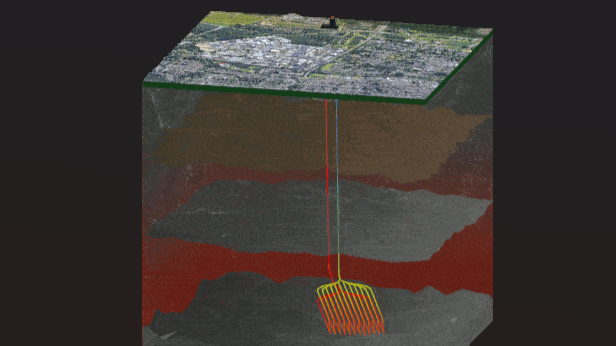
Source: Eavor website
I knew a little about geothermal before I knew much about most other forms of energy...
As a fresh undergrad at the University of Southampton I remember spotting a distinctive red building, not far from Southampton Central Railway Station. This, it turned out, was a geothermal plant and district heating scheme. The history of the scheme goes back to the early 1980s (a long long time before I was at University!). The UK Department of Energy at the time deemed it too small to be commercial. Instead Southampton City Council, under the leadership of former Labour MP, Shadow Energy Minister 2015-2024 and Energy Institute Fellow Alan Whitehead CBE FEI, went ahead and developed the UK's first geothermal project. Taking geothermal heat from 1800m below the surface, the project first started producing energy in 1986. Nearly forty years on, the project provides heating, cooling and power for a significant district scheme, serving multiple civic, business and residential needs. Find our more here: Southampton District Energy Scheme
This edition covers a long-established form of energy production, but one that is currently going through a renaissance as the technology around geothermal evolves. 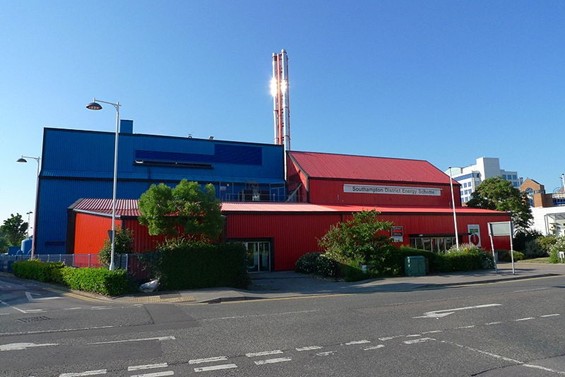
Source: Think Geoenergy,
Geothermal technologies
Geothermal is a potential source of 24/7 heat and electricity. At its most basic, many of us have seen naturally-occurring geothermal springs which produce hot water, often as a tourist attraction. such as the Roman Baths, in Bath. However, to generate electricity normally requires the drilling of wells ranging in depth from several hundred to several thousand metres. In cases where dry steam is produced this can be used directly to power a turbine to generate power. More typically, where hot water is produced this is used to heat a fluid with a lower boiling point than water, which in turn powers a steam turbine. These projects have relied on geology where there is a significant source of water or steam (i.e. an aquifer). Historically, such projects have been open system - in so much as the fluid, once cooled, is returned to a separate part of the reservoir. Ground source heat pumps are also a form of geothermal energy, which I covered under The A to Z of the Energy Transition: A is for Air Source Heat Pump) so I won't cover that further here.
Recent progress has led to the development of closed-cycle systems where rather than taking water or steam from the rocks, a fluid is circulated in a piped system. Such Advanced Geothermal Systems (AGS) bring the major advantage that there does not need to be a fluid contained within the rocks, the heat of the subsurface can simply be transferred to a dedicated fluid running through a pipe. As such, the geology in which such technology can be deployed is far greater than conventional geothermal - practically anywhere in the World. Canadian firm, Eavor Technologies Inc., which both bp and Chevron have invested in, is in an early pioneer in this closed-loop technology.
Other advances in geothermal technologies include Enhanced Geothermal Systems (EGS), which incorporate solutions used by the oil and gas sector, such as hydraulic fracturing (fracking) to allow reservoir fluids to flow through otherwise impermeable rock. 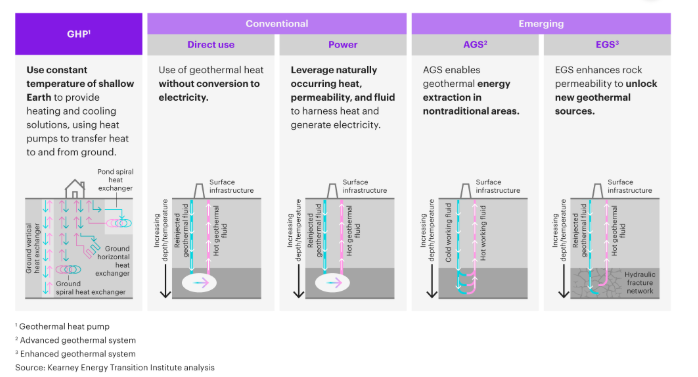 Schematics of geothermal technologies. Source: Kearney Energy Transition Institute
To learn more about different technologies, you can find out more with this helpful guide our friends at the Kearney Energy Transition Institute produced: Geothermal energy: turning up the heat - Kearney Energy Transition Institute
Geothermal projects across the globe:
The following section comes from my Energy Institute colleague Gemma Fox (Senior Energy Analyst) and someone who spent time studying geothermal as part of her degree at Durham University.
While geothermal energy makes up a small proportion of the global energy mix, there are a huge number of projects globally and crucially lots of potential. Here I’ll provide a brief overview.
There are around 25 countries commercially generating geothermal electricity, and an additional 82 countries are using geothermal heat directly.
Iceland stands as perhaps the world's most successful example of geothermal utilisation. Blessed to be geographically located on the Mid-Atlantic Ridge, Iceland generates approximately 25% of its electricity from geothermal sources. More impressively, geothermal heating systems warm about 90% of Iceland's buildings. It was back in the 1930s that Iceland’s capital city Reykjavik ditched coal heating for geothermal district heating – talk about being pioneers in the energy transition! The Hellisheiði Power Station, one of the largest single-site geothermal power plants globally, continues to innovate with carbon capture and storage techniques as Iceland looks towards decarbonising the hard-to-abate sectors. You can read more about Iceland’s energy transition here: A tale of two transitions: The Energy Institute’s Country Transition Tracker highlights the disparity of energy challenges faced across the world
The United States and Indonesia are the largest global producers of geothermal electricity, each with around 17% of the total global capacity (~2.6GW each). The US is home to the world’s largest geothermal power plant, The Geysers, located in California, which generates 1500 megawatts. Remarkably, a 2019 Department of Energy, GeoVision analysis indicates that US capacity could increase to 60 GW by 2050—providing 8.5% of U.S. electricity generation. And, if Enhanced Geothermal Systems become commercially viable that capacity could reach 90 GW. It also indicates the potential for geothermal heat pumps to supply heating and cooling solutions to 28 million households and for 17,500 geothermal district heating systems nationwide.
In Africa, Kenya is already utilising the East African Rift to generate 45% of its electricity demand from geothermal. According to Rystad Energy, Africa’s total installed geothermal capacity is expected to more than double by 2030 as the African geothermal sector is forecast to attract at least $35bn in investments by 2050. You can read more about their analysis here: Picking up steam – Africa to overtake Europe in geothermal capacity
But there is also potential beyond volcanic regions.
The UK, being tectonically inactive, isn’t necessarily a country that comes to mind when you think of geothermal energy, but there are already operational geothermal heating projects here in the UK. In 2023, the Eden Geothermal project came online - the UK’s first operating deep geothermal heating plant since 1986 [the above project in Southampton], which supplies heating to the Eden Project biomes and greenhouses. For Eden Geothermal the next step is electricity generation from geothermal energy in Cornwall, the potential of which could be larger than Hinkley Point C! (Geothermal potential in Cornwall and the UK – Eden Geothermal).
Another interesting development taking place in the UK, is harnessing geothermal heat from disused coal mines. The first large-scale mine water heat network opened in Gateshead in 2023 which heats more than 350 buildings and a new project in Seaham is under construction and expected to heat 750 new homes. Projects like this really show how the infrastructure and communities of our industrial past have a role to play in our greener future. You can read more about how these projects work and the potential across the UK here: How flooded coal mines could heat homes - BBC Future
Geothermal energy represents a promising avenue for sustainable power and heating solutions worldwide. From the volcanic landscapes of Iceland to the tectonically inactive regions of the UK, each country is discovering innovative ways to harness the Earth's natural heat. As global investments grow and technology advances, geothermal energy has the potential to significantly contribute to the global energy transition.
Thanks Gemma Fox for your excellent contribution!
So what's next?
Does geothermal remain a fairly niche technology in the energy transition, or can it scale and come down the cost curve like wind and solar have? It is certainly encouraging to view geothermal no longer as limited to those areas of the planet with suitable geology but applicable practically anywhere, using new technologies.
Geothermal has a lot going for it, in delivering steady 24/7 'base load' energy and the additional benefit of being to provide both electricity and heat. The question is whether it can compete with the alternatives - solar + storage, small modular reactors or simply using ground source heat pumps to gain the benefits of the heat of the earth's surface but at much lower depths.
Further reading
Finally, as always please see further reading on this subject from the Energy Institute's New Energy World Magazine
Geothermal electricity – plus heat – is now viable in the UK
Geothermal energy: Germany’s gateway to a more sustainable future
Underground heating: a review of deep geothermal energy
The potential of geothermal energy in Europe
Cornish deep hot rock developments
Kenya’s path to universal power – a blueprint for sub-Saharan Africa?
