
The A to Z of the Energy Transition: B is for Bioenergy
Bioenergy is any form of renewable energy or fuel derived from biological sources. This includes everything from very rudimentary burning of wood through to highly advanced forms of biofuel.
The critical aspect of any form of bioenergy is that it removes carbon from the atmosphere as it grows, which is subsequently released into the atmosphere when it is combusted, so it effectively reduces CO2 to the atmosphere before it is used.
For bioenergy to be both 100% carbon neutral and renewable there are at least three key factors:
1) The source needs to be replaced in the same timescale in which it is consumed;
2) The whole supply chain, including transportation, needs to be as close to carbon neutral as positive;
3) The source of the bioenergy should be additive and not substituted from other uses e.g., food.
Clearly issues of biodiversity, sustainable farming and many other factors also matter. I won’t get into the complexities and controversies over different forms of bioenergy, but clearly it is unlikely that any form of bioenergy meets all three criteria 100% of time. Therefore, most bioenergy will reduce emissions vs. their fossil alternative but not completely eliminate them (this reference from the UK’s Forestry Commission gives some comparisons between different feedbacks for electricity generation: Carbon emissions of different fuels - Forest Research.
And for anyone who really wants to get into the science, here’s a complex article GHG displacement factors of harvested wood products: the myth of substitution - Scientific Reports
The potential exception to this is when the CO2 is captured again at the point of use (combustion). This process is called BECCS (Bioenergy with Carbon Capture and Storage). If done effectively, this will result in negative emissions, i.e., CO2 is taken from the atmosphere when the bioproduct is grown and any subsequent CO2 from combustion is safely capture, stored or converted into other products. So, bioenergy done well can be carbon negative, bioenergy done poorly may be no better or even worse than a fossil fuel counterpart.
I'll cover some of the key types of bioenergy now:
1. Solid biomass
At its most primitive this is simply the use of wood or animal dung for cooking and heating. According to the World Health Organisation around 2.1bn people still cook using such fuels (although this figure also includes non-bio energy, such as kerosene and coal. And this great chart from @Our World in Data shows how this evolved between 1980 to 2010. Share of population using solid fuels as the main cooking fuel, 1980 to 2010
Solid biomass is also used for power generation, often in the form of pellets produced from sawdust or other waste wood, to fire boilers and generate electricity via a steam turbine. According to National Energy System Operator around 7% of GB’s electricity in 2024 came from biomass.
2. First generation biofuels
Biofuels are liquid fuels produced from organic matter, largely used in transportation. The term ‘drop-in’ fuel is applied to such fuels which can either be blended with fossil-based equivalents or used as a 100% switch.
At their most basic, an older diesel car could run on biodiesel from used vegetable oil, with minimal or even no conversion. Whilst this was somewhat popular in the early 2000s, it is not recommended for a modern diesel and might get you in trouble with the tax authorities! Modern bio diesels are typically produced in complex refineries from FAME (Fatty Acid Methyl Ester), largely sourced from vegetable oils.
For petrol / gasoline vehicles, bioethanol, an alcohol made by fermenting plants such as corn and sugarcane, has long been blended into regular fuels. E10 is now the UK standard for gasoline, which contains up to 10% renewable ethanol. Unless a vehicle has been converted or purpose built, higher proportions of ethanol can cause engine damage through corrosion to metal and degradation of rubber components. Brazil’s significant production of sugar-cane derived bioethanol has resulted in a car fleet that is predominantly able to run at up 100% bioethanol.
According to the Energy Institute Statistical Review of World Energy, globally production of biodiesel and biogasoline was about 2.1 million barrels per day in 2023. This compares with around 100 million barrels per day of global crude oil production. But forecasts show significant growth out to 2030, as this outlook from energy analyst Robert West, CFA at Thunder Said Energy highlights.
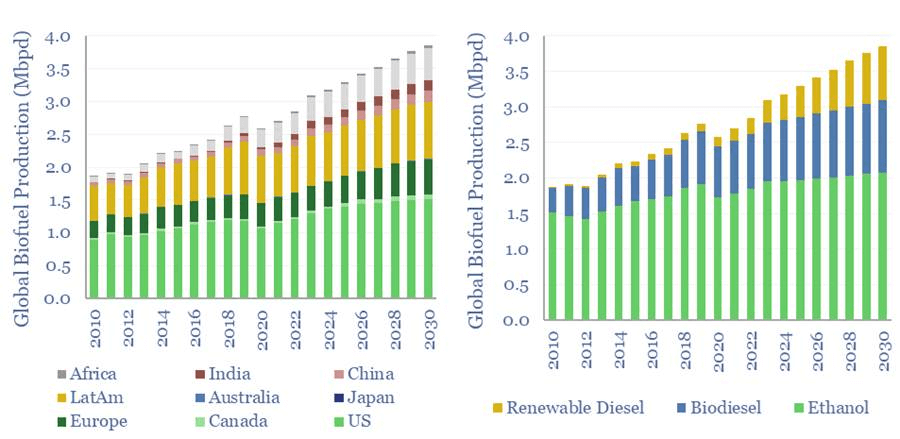
Source: Thunder Said Energy, Biofuel forecast to 2030.
3. Advanced (second generation) biofuels
Beyond these first-generation biofuels are an increasing variety of advanced (or second generation) biofuels, being developed for more specialist uses, such as SAF (sustainable aviation fuel). SAF is produced from a range of bio (and non-bio) feedstocks, using more advance processing including reactions with catalysts, hydrogen and the Fischer–Tropsch process to gasify solid biomass and convert it into liquid form). Companies like LanzaTech, led by Jennifer Holmgren HonFEI, are doing leading-edge work in this area.
SAF is currently blended into fossil aviation fuel at low percentages. The ReFuelEU Aviation Regulation has set a mandate starting with 2% in 2025, which increases to 70% in 2050, although trials have successfully completed with 100% SAF (The future of flight takes off as Virgin airliner crosses Atlantic solely powered by sustainable aviation fuel - GOV.UK.)
Beyond cost, the biggest challenge is likely to be securing sufficient volume of SAF. There is a strong case that as EVs grow rapidly, biofuels should be targeted towards sectors which are harder (or impossible) to electrify, such as aviation. So fabulous as those 100% bioethanol cars are in Brazil, it may not be the most effective way of decarbonising the planet.
The Energy Institute is playing an important role supporting the aviation and fuel industries in developing the test methods which are used to check for fuel quality and contamination of SAF.
4. Biogas / Renewable Natural Gas
Biogas or RNG (Renewable Natural Gas) is typically produced through either the anaerobic digestion of organic matter by bacteria or simply collected from a high concentration source of methane, such as landfill sites, sewerage systems or animal emissions.
There is a lot of debate at the moment on how material biogas could be as a replacement for natural fossil gas. In 2022 bp invested $4bn in Archaea Energy which collects biogas from multiple farms and landfills to either generate power or go directly into the gas grid.
To find out more on the processes around biogas, here’s a helpful article from Severn Trent.
Understanding the basics of anaerobic… - Severn Trent Green Power (thanks to Samantha Smith at REA for sharing).
5. Algae derived bio products
R&D investment into algae-derived biofuels, has taken place for many years. In short, fast-growing algae is cultivated in an open or closed body of water, which is then harvested and processed to remove lipids (natural oils), which are processed into fuels. I am not aware of any operating large-scale commercial algae yet (but happy to be corrected). One interesting company to look out for is HutanBio, who are developing an algae-derived drop-in biodiesel.
Interestingly as recently as two weeks ago the US Department of Energy announced $10m funding in this area. I don’t know if this will continue under the new administration. Department of Energy Announces up to $10 Million for Algal Systems Research and Development to Expand U.S. Bioenergy Feedstock - Department of Energy
So in conclusion...
Bioenergy is already a significant and rapidly growing part of the energy system. Its impact on CO2 emissions can have a huge variation, depending on many factors across the supply chain. Bioenergy already play a meaningful role in power generation and ground transportation but their ability to scale into sectors such as aviation will require Government mandates, incentives or taxes, and they may rely on bio being substituted out of parts of the energy system that can be more easily electrified.
This is such a broad topic that this short blog probably hasn’t done it justice. I'm sure some of you will pick up on things I've missed or maybe got wrong so I've also attached a few more reading links below, most of which are from the Energy Institute's New Energy World magazine.
Further reading:
Bioenergy - IEA – a helpful over from the International Energy Agency (IEA). Thanks to biofuel guru, James Primrose for sharing.
The ‘push-pull’ debate around using biomass
A new era for biofuels traceability in Europe
Big Oil bets on biofuels as part of energy transition
Biofuels: one piece of the decarbonisation jigsaw
Using 100% SAF could reduce climate-warming effect of commercial aircraft contrails
UK SAF mandate becomes law as government revamps aviation net zero taskforce
