
The A to Z of the Energy Transition: W is for Workforce
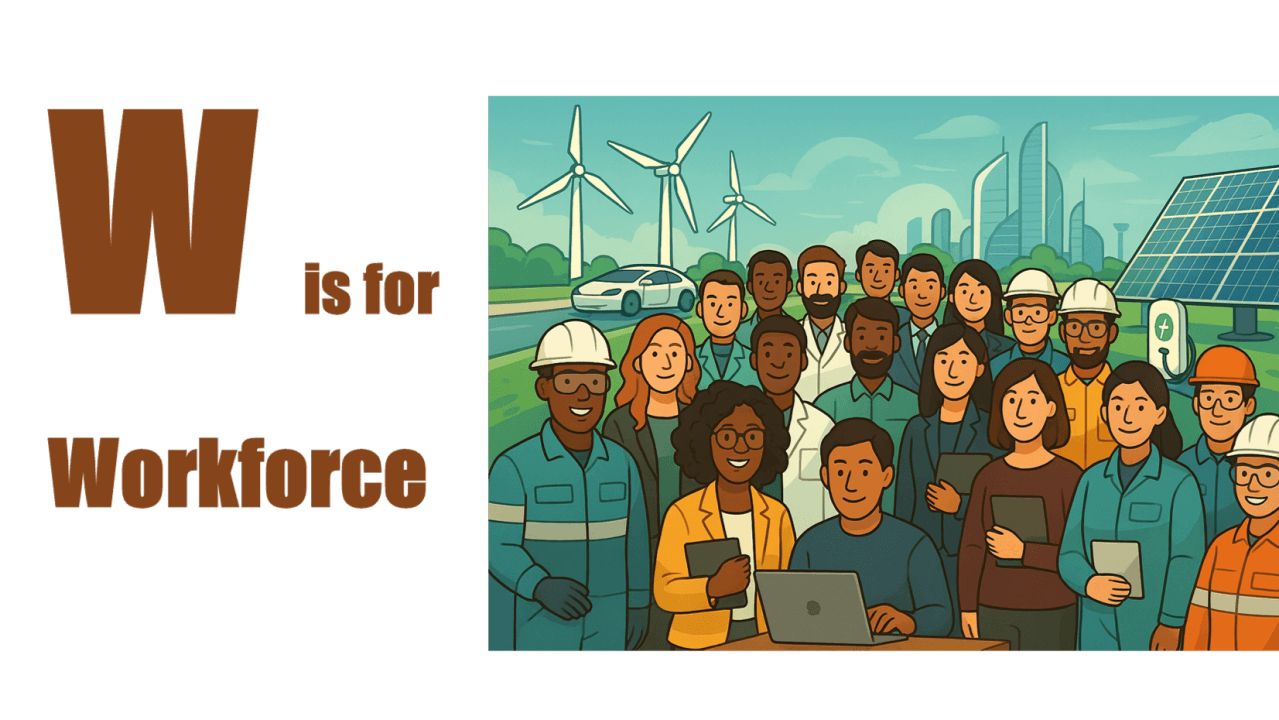
Most of the letters of the A to Z have focused on technologies, policy and infrastructure, but ultimately every technology, policy and infrastructure is designed, built and operated by people (at least for now). It is estimated that there are some 67.5 million people working in the energy sector across the world according to the International Energy Agency (IEA) . That’s nearly the size of the entire UK population or two Malaysias. These jobs are split roughly half ‘traditional’ fossil roles and half renewables / transition.
Unsurprisingly this figure is expected to grow massively over the coming decades. The International Renewable Energy Agency (IRENA) forecasts that an accelerated energy transition could create 40 million additional jobs in the energy sector by 2050, including 18 million in renewables alone. The International Energy Agency (IEA) also estimates that 14 million new clean energy roles will be created globally by 2030, alongside the reskilling of 16 million workers currently in conventional energy
Here in the UK, the Government recently published a clean jobs plan, which anticipates the UK energy work force nearly doubling from 440,000 in 2023 to 860,000 by 2030.
In this edition I want to focus on three aspects of the workforce:
1. How do we attract talent to the energy sector?
2. How do we develop talent required to deliver the energy transition?
3. How do we ensure a just transition for those who work in traditional forms of energy?
4. What are the implications of AI for the energy workforce?
How do we attract talent to the energy sector?
I’m biased, but I would argue that no other sector on the planet is more exciting, dynamic or important to the future of humanity. But historically energy has struggled to attract young and diverse talent. Of course this varies by location, in some countries energy is the biggest sector and a big draw for fresh talent. In markets like the UK, energy often struggles to compete with sectors like finance, although this is evolving as the transition becomes more prominent. Surveys show that a large majority of young energy professionals are motivated by climate action, underscoring the need for employers to connect roles with impact. No other industry is as critical to tackling climate change, bringing lifeblood to our global economy and helping lift hundreds of millions of people out of poverty.
The Energy Institute's global Young Professionals Network (YPN) has long led the way in thought leadership with the next generation of leaders, through its Generation 2050 initiative, through ongoing series of engaging events around the world - we have multiple YPN communities in the UK (including London, Aberdeen Highlands & Islands, West Midlands and Southern Scotland), and as far away as Malaysia, Nigeria, Hong Kong and the Middle East. Just earlier this week the YPN released a deeply insightful report on Generation 2050 - ‘25 years out’ Young professionals sceptical that energy sector can deliver energy transition, Energy Institute, which they also discussed on a webinar: https://youtu.be/PER3JP0zodI.
A special guest writer will be writing a lot more on the role of younger generations in the energy sector in a coming edition.
We also need to do far better on attracting a much more diverse workforce. Women represent only 16% of the global energy workforce, despite making up 39% of overall employment. Progress has been slow. The Energy Institute is very proud to be the home of POWERful Women which has campaigned, connected and provided practical support for over a decade to drive stronger female representation at senior (and all) levels in the UK’s energy sector. During this period female board representation increasing from 9% to 29%. We still have a long way to go to reach POWERful Women’s 40% female representation at all levels by 2030 target. And of course, diversity and inclusion, goes beyond gender. The Energy Institute works with many other initiatives, including Tackling Inclusion and Diversity in Energy (TIDE) , Energyz Black and Pride in Energy to make progress in the energy sector's inclusivity.
How do we develop talent required to deliver the energy transition?
The energy transition not only requires tens of millions more people but a healthy combination of existing and new skills. I’ll cover the former in the next section but in terms of future skills it’s important to recognise that the transition will require a completely different set of skills to the ones that got us here.
We surveyed our members in the Energy Institute 2021 Barometer, when we focused in on skills with the following findings:
Engineering and technical skills still remain the most sought-after by employers, followed by whole system thinking, critical thinking and analysis, and project management.
51% of respondents cited the need to invest in upskilling and retraining (I'm sure that percentage would be higher now)
- 57% of respondents reported that they were planning to undertake training in the next year as a result of net zero, though many had concerns about cost, time and availability of courses.
- The same number pointed towards investment in skills in the existing workforce as necessary for a just transition, with 57% wanting to see support specifically for skills and retraining to avoid oil and gas professionals being left stranded.
We are moving from an energy system which started with 'supply push' and often didn’t care or even know who the end consumer was, to 'demand pull', where consumers will be at the heart. This puts far more emphasis on skillsets such as behavioural science, design, data analytics and marketing. Left to engineers, a heat pump or EV charger would not look very attractive to most customers. Engaging with consumers (be that households, businesses, hospitals and schools etc.) will be a critical enabler to adoption of new technologies and different behaviours. Adoption of iPhones has not been driven by cost (they are often multiples more to rival brands) but because they look COOL and people LOVE the user experience.
Similarly, we will need the smartest programmers to figure out solutions on how we optimise the electricity grid; the greatest physicists to figure out how we finally crack fusion; innovative energy managers to help businesses optimise their consumption; and so many more disciplines. I personally find it incredibly exciting that our sector needs such breadth and depth of talent. But there are some big gaps, particularly in digital. In the recent Generation 2050 - 25 Years Out report, that I mentioned above, only 30% of respondents feel proficient in digital and AI skills, pointing to a growing gap in digital capabilities within the workforce.
It will take a different approach to build these skills and apply them across the energy sector. Alongside, other skills bodies the Energy Institute provides a broad range of training from our EI Academy, professional recognition (including chartership) and many other services, including mentorship, networking events and a huge range of knowledge resources that support individuals throughout their careers. We are also the only body in the world that charters energy managers Chartered Energy Manager, Energy Institute
There are also lots of other important ways we support career growth, including CPD career pathways, mentoring, as well as soft skills. You can find out much here: EI Academy, Energy Institute
And of course, if you're not yet a member of the Energy Institute please sign up here: Membership, Energy Institute!
How do we ensure a just transition for those who work in traditional forms of energy?
I discussed the importance of supporting individuals and communities transition roles and local economies under J is for Just Transition and O is for Oil and Gas. I cannot emphasise enough how important it is that we don’t leave people behind, as the oil and gas sector declines. Since writing about Aberdeen in those editions, the plight of workers has become even tougher. Recently Petrofac entered administration, threatening up to 2000 roles. Many other companies have announced layoffs.
Of course, Aberdeen is just one centre for oil and gas, but there are many other cities around the world which may face similar challenges in the future: Stavanger, Lagos, Perth, Houston to name a few. How the workforces of such cities transition matters both for the wellbeing of generations of families and communities (just look at the poverty that still exists today in parts of South Wales, where coal mines shut over four decades ago) and critically in ensuring we have the skills required to deliver the transition. Many of the skills required to deliver the transition are directly transferable from oil and gas (mechanical, electrical and instrument technicians, engineers, marine experts etc. etc.), others may be less obvious but still relatively straightforward to transfer.
As demand for expertise in energy grows, 86% of professionals would consider moving to another role, with 62% open to opportunities within traditional energy, according to the ninth annual Global Energy Talent Index (GETI), produced by Airswift. They also highlighted that Interest in switching to renewables has also surged, rising from 56% in 2023 to 71% in 2025.
But this is not always easy. There are often cultural differences between different parts of the energy sector. And in some areas people may have to requalify / recertify to move sectors. It was pleasing to see Offshore Energies UK, RenewableUK and both the UK government and The Scottish Government take an important step forward launching an energy skills passport earlier this year. Energy Skills Passport launches, helping workers transition across the energy mix
There is much more to do this in place to make it seamless for people to move from one sub sector of energy to another, as well as addressing challenges on mobility and the reality that most oil and gas jobs are higher paid than renewable jobs.
There's also some great work underway in Aberdeen by the Energy Transition Zone Ltd, under the leadership of Maggie McGinlay (and one of our brilliant former Young Professionals and now Vice Chair of Energy Institute - Aberdeen Highlands & Islands branch, Anna Maclaren, also works). ETZ is doing great work around Aberdeen, regenerating land to create skills and new business opportunities on the transition. They recently opened Scotland's largest Energy Transition Skills Hub: ETZ Ltd, First Minister officially opens Scotland's largest Energy…
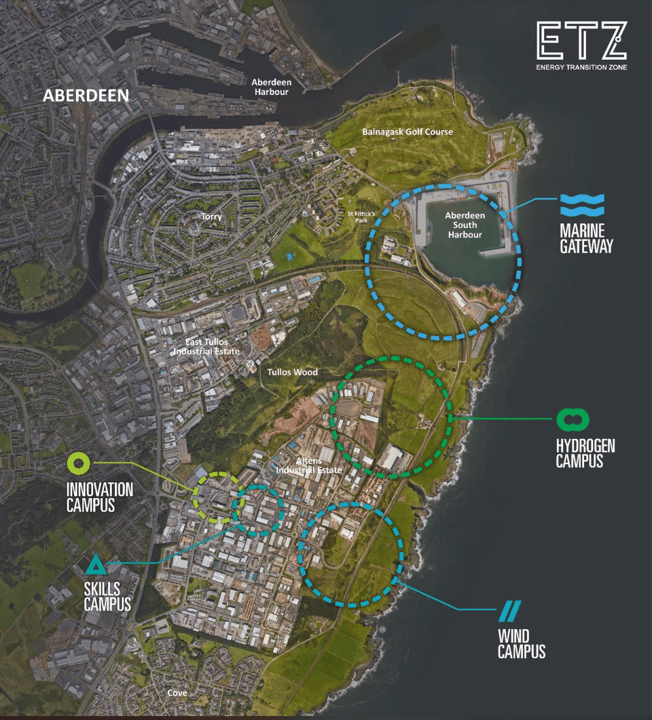
Map of Aberdeen showing Energy Transition Zone sites - Source: ETZ
What are the implications of AI for the energy workforce?
There’s been huge hype about the impact of AI on energy demand and I’ve discussed the role of AI in energy across several letters, particularly D is for Digitalisation, but what about the impacts of AI on the energy workforce? Automation is not new to the energy sector, compare a modern offshore drill rig to one in the 1990s. Likewise, technologies such as remote vehicles and drones are replacing humans in maintenance inspections from transmission grids to refineries and storage tanks. Whilst taking people out of harm’s way is clearly positive, ultimately these technologies inevitable drive efficiency through reducing the number of people.
So how will AI affect other roles? The simple truth is that I don’t know, I’m not sure if any of us know! AI is playing an increasing role in roles which analyse vast amounts of data, particularly across disparate data sets. Interpreting complex subsurface data can massively accelerate processing times for geologists working on upstream oil and gas (or CCUS), it can also help engineers optimise refineries in real time. For now, these tools largely enable highly trained professionals be far quicker and more efficient, rather than taking their jobs. When might those jobs been at risk of being replaced by a computer?
AI is also helping to create entire new business models and therefore new jobs. Optimising electrical grids, millisecond by millisecond, matching demand and supply is creating exciting new flex businesses. Companies like Kraken, Kaluza and Envision Energy have built impressive platforms doing just this, introducing a whole new 'tech' workforce to the energy sector. Similarly, technologies such as dynamic line ratings, which adjust the capacity of transmission lines according to wind speed and ambient temperature are ripe for AI-enabled businesses. My strong conviction is that have yet to see even the tip of the iceberg of how AI is going to revolutionise energy.
The question is how many jobs will this create and where will they be ?
My strong conviction is that many of the energy companies and much workforce of the future will not be the same as the past.
With thanks to the Energy Institute's Lydia Malley for many of the data points and links.
Further reading
And some further reading from the Energy Institute's New Energy World Magazine, courtesy of Will Dalrymple.
News
UK unveils plan to create 400,000 green energy jobs by 2030
Global wind workforce requires major expansion to meet 2028 targets
US and UK take steps to reskill workers for the energy transition
UK offshore energy sector faces mass redundancies
A call for collaborative leadership in energy
Bridging the skills gap to empower Europe’s solar future
Why and how we must secure tomorrow’s engineers for a greener future
Delivering our energy future – pathways to a ‘just and fair’ transition
Feature
How to address the skills gap in a future UK hydrogen economy
