
The A to Z of the Energy Transition: I is for Investment, Infrastructure and Insurance
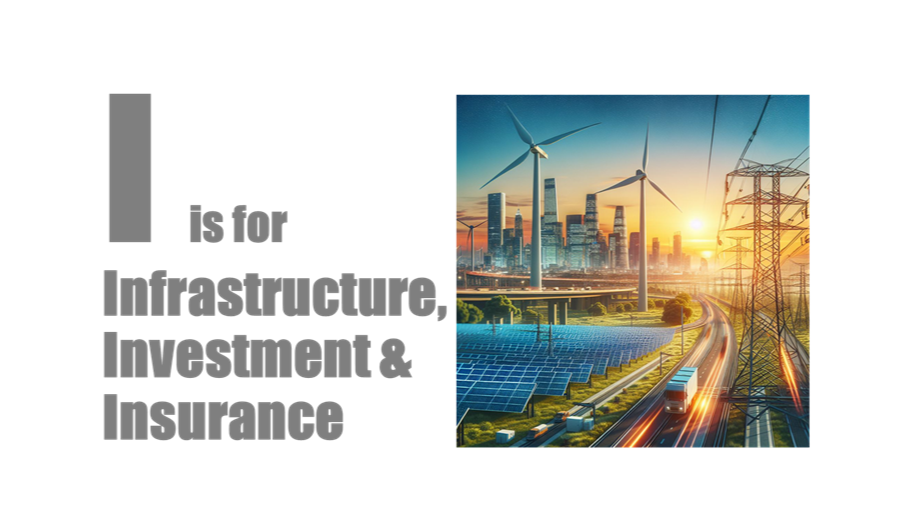
For this edition, I’m delighted to have a guest writer – Rachel Bravard.
Rachel is a value creation expert with extensive experience in the global energy industry, having lived and worked in four continents. After training as a lawyer at A&O Shearman, she moved to financial and commercial roles focussed on infrastructure, investment and energy at Balfour Beatty Investments, General Electric and Shell. She currently runs Vallard Global, a boutique advisory firm focused on guiding companies to develop and realise innovative commercial growth models in the energy and mining sectors.

This edition's guest writer, Rachel Bravard.
Over to you, Rachel…
Infrastructure
One of the most overlooked elements of our daily lives is that the ability to produce the energy we need depends almost entirely on infrastructure. Whether we speak of electrons (from green or fossil-based sources) or molecules (such as gas or hydrogen), these are produced, transported, and stored thanks to infrastructure, both physical and virtual. Even AI, which we think of as software, is fundamentally linked to infrastructure risk. According to Statista, 87% of NVIDIA’s Q4 2024 revenue is attributable to data centre solutions, meaning that most of the equity value of NVIDIA is tied to the ability to build functioning data centres, and therefore to years-long grid connection queues fundamental to powering those data centres.
Almost all parts of our economy depend on the resiliency and efficiency of energy production infrastructure: the cost of energy production, storage, and transportation is a key driver – or brake – to our economic prosperity, whether we are using that electricity to power manufacturing facilities or software companies.
Fossil-fuel-based infrastructure has, historically, been the cheapest, most easily storable, and transportable form of energy. That remains true in some parts of the world today, while in others, those economics increasingly favour renewable energy solutions. Economic drivers are at times due to geography: gas is cheaper in America, where it exists under the soil, than in Europe, where it is largely imported. Similarly, hydropower is a relatively cheap option in Norway, where the country’s natural topography lends itself to this gravity-based energy storage solution, which would obviously not be as attractive in Qatar, where solar power or natural gas are more obvious options. Indeed, as we move to a more volatile political landscape, there is an increasing expectation that the energy infrastructure built globally will focus on ensuring energy security, and therefore local production to the greatest extent possible. I also believe the physical and cyber security of energy generating assets globally will become an increasing focus of governments and populations alike.
There are political and social fights constantly about what type of infrastructure we should be building: “Gas! Coal! Nuclear! Solar! Wind! Heat Pumps! Hydrogen! Oil! Anything but oil!” However, there is consensus that the nations of the world need the most efficient infrastructure they can afford as modernisation demands increasing amounts of power. Whether it is the move from hand-washing clothes to using a washing machine, or from standard computing to machine learning, social and technological progress in all geographies requires that we either produce more power or at least use it more efficiently. So, what is stopping us?
Global supply chains are key to enabling the construction of further infrastructure – whether pipelines for transport of gas within a continent or more expensive LNG terminals for the transportation of liquified natural gas across oceans, such as the gas imported from the middle east, Australia and the USA around the world. This is no different for the complex supply chains of green infrastructure – from lithium ion to cobalt and nickel, the list of minerals needed to produce green infrastructure is long, though with some geographic concentration. By example, 90% of the lithium produced in the world is from Australia (50%), Argentina, China and Chile. China has been particularly adept at controlling the supply chain of green technologies. The incredible speed at which the cost of solar panels and lithium-ion batteries has decreased in the last decade has in no small part been thanks to China’s dominance of that supply chain. “China is exporting green energy tech so cheaply that the rest of the world is thinking about erecting barriers to protect their own industries,” according to Matthias Kimmel, head of energy economics at BloombergNEF. However, it is thanks to these cost efficiencies that the world has been able to invest in more projects to enable the proliferation of renewable energy globally.
Investment
Energy infrastructure, small (solar panels) to large (oil platforms, wind farms), depend on investment, whether self-financed by a homeowner or by a consortium of investors; money must be put in before the infrastructure is installed, built, or producing any useful output. According to the International Energy Agency, investment in energy exceeded $3tn for the first time in 2024, of which around $2tn was energy-transition related. These capital costs are therefore made on the assumption that the benefit of the infrastructure will be justified over its lifetime, ideally producing far more value in terms of energy produced than the cost of construction.
Looking at it from a small scale, for a homeowner installing solar panels, the maths is essentially a question of how many years it takes for the electricity produced by the panels to reimburse the hardware and installation cost. This can be 6-12 years depending on how much sunlight is in that house’s geography, or higher cost if for example the system includes batteries or is hard to access. Ideally, the panels and batteries last longer than the repayment period, so the capital cost is repaid in fewer years than expected (let’s say 5 ), while the hardware lasts longer (let’s say 15 ), providing the homeowner with as much “free” electricity production as possible (in this case 10 years).
Commercial projects are typically funded by a combination of equity (shareholder’s capital) and project finance (or debt). To secure project finance (to make it ‘bankable’) projects are normally underpinned by some form of offtake agreement, which allows the investor to guarantee a revenue stream for the first X years of the project’s life. For renewable electricity such contracts are typically known as PPAs (Power Purchase Agreements), which lock in electricity prices for a set number of years at a fixed price (typically inflation linked). Another form of price guarantee is the CFD (Contract for Difference) mechanism, which has been used by the UK to incentive technologies such as offshore wind. Rather than securing offtake, it secures a guaranteed ‘strike price’ for the investor. If the market price of electricity is below the strike price the Government makes up the difference; if the strike price is above market the Government retains the upside. The CFD mechanism has proved particularly successful in securing long-term investment in offshore wind and is now being applied to new infrastructure such as CCUS and hydrogen projects. Without the guarantee of a revenue stream, it becomes impossible to raise debt to fund the construction of the project.
This basic premise around ensuring capital invested will be worth the return is essentially what makes our new energy technologies so expensive to implement, and therefore, hard to scale. As we try to bring in new technologies to store power better, produce power more cheaply or manage it more efficiently, we need to make assumptions that their cost will be less than the financial value they create. It is very difficult to make those assumptions on new technology when, by definition, we don’t have the data over years necessary to offer a guarantee of those benefits over time. So, financiers need to build in a “risk premium” or extra return to cover the risks of failure they are taking on. For many new technologies, this makes commercialisation of the technology challenging. In other words, while a few startups can find a small number of people (such as angel investors or venture capitalists) willing to finance one test site to be built, getting several sites built or mass manufacturing new hardware is expensive, and there simply aren’t enough buyers willing to take on enough risk. However, for established technologies such as solar and batteries, supply chain efficiencies (as mentioned above) have resulted in low capital costs. Together with the economics of zero variable cost which renewables provide, the result is so affordable now that new solar plants, even without subsidies, are within touching distance of new US gas plants. This is remarkable especially when US gas prices are only a quarter of prevailing gas prices in Europe and Asia, according to BloombergNEF.
Stock image of electricity pylon. Source: Pixaby
Insurance
One of the hottest topics in energy transition and climate adaption is insurance. It matters for two key reasons:
- As climate change leads to increased frequency and intensity of extreme weather events, insuring existing infrastructure against climate events is increasingly important.
- Insurance is a critical enabler for new technologies, such as CCUS and hydrogen, without which it becomes impossible to raise debt to construct the project.
Insuring against climate risks
Focusing first on the impacts of climate change, it’s important to understand the difference between an insurance company and a reinsurance company. An insurer is a company that provides insurance coverage to individuals or businesses in exchange for premiums. They assume the risk of paying out claims in the event of a covered loss. A reinsurer provides insurance to insurers. Reinsurers handle risks that are too large for insurance companies to manage on their own, essentially helping distribute and mitigate the risk for insurance companies. As a result, reinsurers are particularly affected by climate risk due to their role in covering large-scale, catastrophic events. The increasing frequency and severity of natural disasters, such as hurricanes, wildfires, and floods, have led to higher reinsurance premiums and stricter underwriting guidelines. Reinsurers often also face substantial volatility in earnings and capital due to these unpredictable events. As an example, the cost of the most recent California wildfires alone is estimated to cost $20-45 billion.
This has had two major impacts which will worsen over time:
In certain locations, the recurrence and severity of climate events have been so extreme that insurance companies have needed to exit those markets as they are simply unable to charge an appropriate fee to justify the risk they are taking on. The US states of Florida and California are good examples of locations where the state has had to step in with significant reform to ensure property owners are able to access insurance, at greater risk to the state. This is particularly difficult in smaller countries of the Caribbean who are suffering from increasingly devastating weather events. It is unclear if or how these states and countries will be in a financial position to continue to support or provide insurance in the face of consistent and worsening climate events.
- Today’s data used by insurance companies is no longer accurate as the past probabilities of occurrence are no longer a suitable guide for what the future holds. Insurance companies should therefore be incentivised to invest in ways to reduce climate change such that they can both quantify risk and charge an appropriate fee for taking on that risk. However, they are limited in what they can do (they are not investment companies) and they need help from the market to drive this forward. The impact decarbonisation has on “saving” the insurance market will depend on the speed at which capital can be deployed and the impact of climate change can be reversed. The data is not currently very encouraging in this regard.
As much as insurance gets a bad reputation for always trying to avoid paying out, it is devastating to both the insurance market and its customers if we come to a position where it is no longer financially viable for insurers to offer their services. It is imperative that insurance companies continue to thrive so that we may all benefit from the protection they provide in times of unexpected hardship.
Insuring new technologies
As new energy technologies have emerged, such as solar, wind, CCUS, battery storage and hydrogen, the insurance sector has had to get comfortable with covering new risks, such as damage from hail to solar panels, or to wind turbines from typhoons. Without decades of historic data, it is more challenging to accurately assess underwriting risk. And without insurance it becomes impossible to secure debt finance and therefore to construct the project.
Publishing standards and technical good practices, such as those from the Energy Institute, plays an important role in helping improve design, construction and operating practices, helping better manage and mitigate risks, to ultimately make a project insurable, and therefore financeable. It is increasingly common place to see dedicated large teams of engineers and energy experts in insurance firms helping to better understand the underwriting of new technologies.
Coming together
Insurers and investors are working together to determine solutions on how to understand, quantify, and address climate change through climate-resilient infrastructure. In 2019, a large global consortium with $28 trillion of assets under management joined together under the banner of the Coalition for Climate Resilient Investment (“CCRI”) to agree ways to quantify the value of climate resiliency as part of the cost of physical infrastructure construction. It may take years to see the benefit of this effort, but if investors, insurance companies and infrastructure unite to address climate change impacts, perhaps we can look forward to a more stable future.
Thank you so much for taking the time to pull this together, Rachel! I’ll be inviting one or two more guest writers through the remainder of the alphabet, so please let me know if you might be interested in contributing!
For more background:
Investing in energy security: Carlyle_The_New_Joule_Order
Who We Are - Coalition for Climate Resilient Investment
California wildfire costs impacting insurance: California Wildfires: Issues, Challenges and Lessons for Insurance and Reinsurance - Actuaries Digital and California LA Wildfires: Impact on Insurance & Reinsurance Industry
Further reading from the Energy Institute's New Energy World Magazine - with thanks to Will Dalrymple
Sensing opportunity and risk in Latin American projects
Emerging markets that are attracting energy investment- report
Repurposing infrastructure for the energy transition
Online Resource details
Websites:
Link to LinkedIn post
Keywords: A-Z energy transition
Subjects: Insurance, Energy infrastructure, Investment
