
The A to Z of the Energy Transition: F is for Fusion Energy
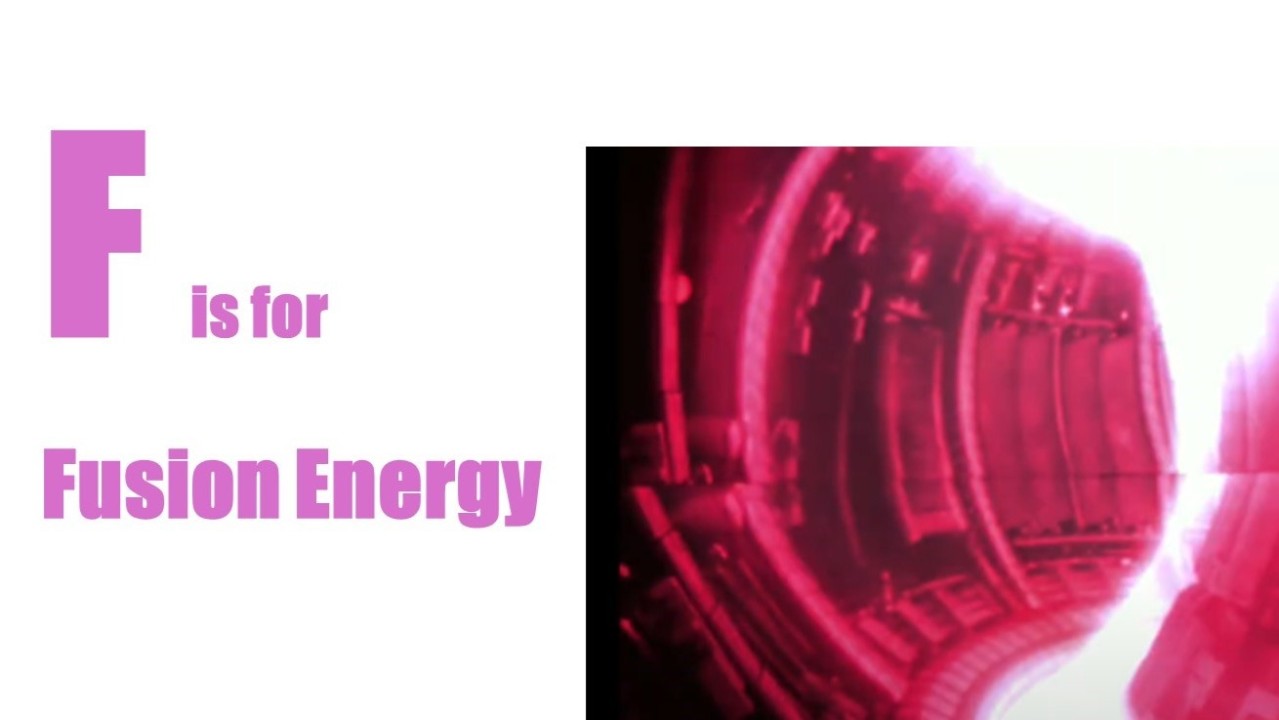
Fusion is just 20 years away and always will be.
An oft-made joke by fusion sceptics but in recent years advances in the science and engineering of fusion are, for the first time, perhaps making commercial generation of abundant zero carbon energy a reality in the future.
What is fusion energy?
My work in this edition has been made a lot easier thanks to this recent joint publication from the Sustainable Markets Initiative, UK Atomic Energy Authority and Energy Institute Fusion Energy 101 Guide.
So I'll just cover the basics here.
Fusion is the same process by which every star and our Sun produces energy. When isotopes of hydrogen ( typically deuterium and tritium) are fused together they form helium and release a neutron, releasing a huge amount of energy. The chemistry is simple but the engineering is far from simple.
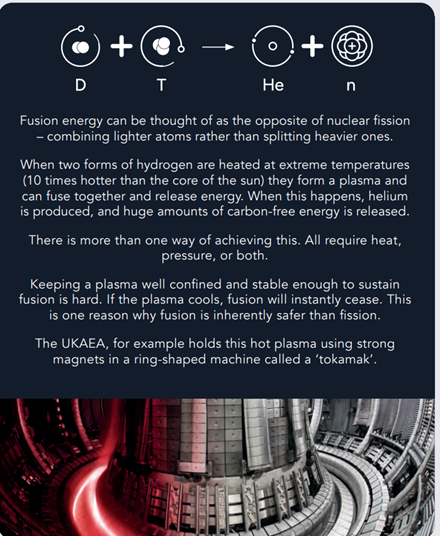
Source: Sustainable Markets Initiative, UKAEA, Energy Institute Fusion 101 guide
In order to create the environment for this reaction to occur temperatures of up to ten times that of the sun (150 million degrees) are required to create plasma. This incredible high-temperature plasma has to be safely contained in a vacuum - either by magnets or by high pressure. The Tokamak is the conventional design when using high powered-magnets - think of a doughnut shape (or a cored apple) surrounded by high-powered magnets. The power of the magnets requires super conductive materials and temperatures close to absolute zero. So in the space of a couple of metres there is a temperature differential of nearly - 273C to 150, 000, 000C!
Despite these immense engineering challenges, fusion is inherently much safer than nuclear fission (the splitting of atoms), as the process needs constant heat and containment to continue. In contrast there is no risk of a runaway reaction, if input power is lost the fusion process stops instantly. As such, the fusion sector in leading countries such as the UK is regulated by bodies such as the Health and Safety Executive and Environment Agency, rather than nuclear agencies.
It's also worth remembering that the primary output of fusion, is heat. This makes fusion not only suitable for generation of electricity but potentially as a means of decarbonising heat requirements for heavy industry.
History of fusion
Research into fusion energy goes back to the 1950s and, in contrast to fission technology, has largely been a global collaborative effort - even seeing collaboration between the US, UK and Soviet Union during the Cold War. European collaboration in the 1970s led to the agreement to build JET (Joint European Torus), based at Culham, Oxfordshire, England. Construction was approved in 1978, with first plasma produced in 1983, prior to its official opening by HM Queen Elizabeth II the following year.
Remarkably JET operated for 40 years, finally shutting down in December 2023, having just achieved the world record of 69 MJ (Mega Joules) for fusion energy generation. JET not only proved to be the largest and arguably most successful fusion experiment on Earth, but it has developed a whole ecosystem of expertise and knowledge around it. The plant will be decommissioned over many years to build further knowledge of the long-term impacts of fusion on materials and to gain confidence in the ability to decommission such plants.
You can watch two brilliant short films on the story of JET: Watch STARMAKERS: The Energy of Tomorrow - Prime Video and soon to be released onto a streaming platform: Star Makers 2: JET's Quest for Fusion Energy (2025) - IMDb
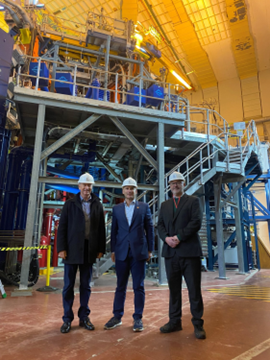
Energy Institute visit to JET (Joint European Torus) at UK Atomic Energy Authority, Culham. From L to R: EI President, Andy Brown OBE FEI, me and EI Technical & Innovation Director Martin Maeso MEI
There are many other fusion plants around the world. In total over 160 plants have been built, or under construction or planned - largely in Europe, North America and Asia. Beyond JET, the site which has created the most headlines is the National Ignition Facility at Lawrence Livermore National Laboratory in the US, which has achieved net positive output (i.e., more energy was produced than went in), producing 3.15 MJ of output energy for 2.05 MJ of input energy. Scientists achieve net energy gain breakthrough with nuclear fusion. The ratio of energy out over energy is known as plasma heating power (Q). So the Lawrence Livermore National Laboratory facility has delivered a Q value of 1.5.
The largest fusion project, currently under construction is ITER (International Thermonuclear Experimental Reactor), in Southern France. The plan for this plant is to deliver 500 MW of heat output from just 50 MW of input power, resulting in a planned Q value of 10. Operations are due to commence by around 2034.
Commercialisation of fusion energy
As the science and engineering of fusion, led by government-sponsored projects, has made substantial progress in recent years private players are entering the sector in increasing numbers - with around $7bn of private funding currently deployed in the sector. Private sector companies often bring in innovation in a particular aspect of fusion technology. For example, Tokamak Energy, originally a spin off from UK Atomic Energy Authority, has made advances in the high-temperature superconducting magnets and a compact tokamak design.
US-based Type One Energy is using advanced high-power computing to model the 3D magnetic fields required to maintain plasma containment. And Commonwealth Fusion Systems, also based in the US, is working towards delivering the first privately-funded net positive fusion plant.
And back in the UK, the UK Atomic Energy Authority is spinning off another business to develop STEP - Spherical Tokamak for Energy Production. Although initially fully backed the UK Government, the intention is to bring in private funding and to create an entire supply chain and ecosystem to develop this project. STEP has already acquired a site at West Burton, Nottinghamshire, England, where the project will be constructed. The site was formerly a coal plant, so already boasts access to the grid and rail access. Ultimately, the first commercial plant is likely to be a partnership between government(s) and the private sector.
One of the important commercial aspects of fusion, is the adjacent technologies and innovations that may be spun off, not dissimilar to the advances that the Space Race had in the 1960s-1970s. Significant advances have already been made in super-conducting materials, as well as materials technologies for managing ultra high and ultra low temperatures. No doubt further advances will come in many areas.
So when will fusion become a commercial reality? Like any sensible commentator, I'm not going to give a specific prediction. But I'll end with a quote shared by UK Atomic Energy Authority CEO Prof Ian Chapman from Russian physicist Lev Artsimovich, one of the inventors of the tokamak,
"Fusion will be ready when society needs it."
Artsimovich died in March 1973 but my hunch is that society is closer than ever to needing fusion. The next decade or so is going to be crucial on the pathway to commercial development of fusion.
Watch this space!
Further reading from the Energy Institute's New Energy World magazine:
Why be optimistic about nuclear fusion?
UK government pushes forward nuclear fusion after JET with £410mn funding
Why UK government hydrogen fuel research is the 21st century’s hottest energy ticket
The new business of fusion
And if you didn't click it please check out the Fusion Energy 10 guide published by Sustainable Markets Initiative, UK Atomic Energy Authority and Energy Institute
