
The A to Z of the Energy Transition: E is for Energy Efficiency
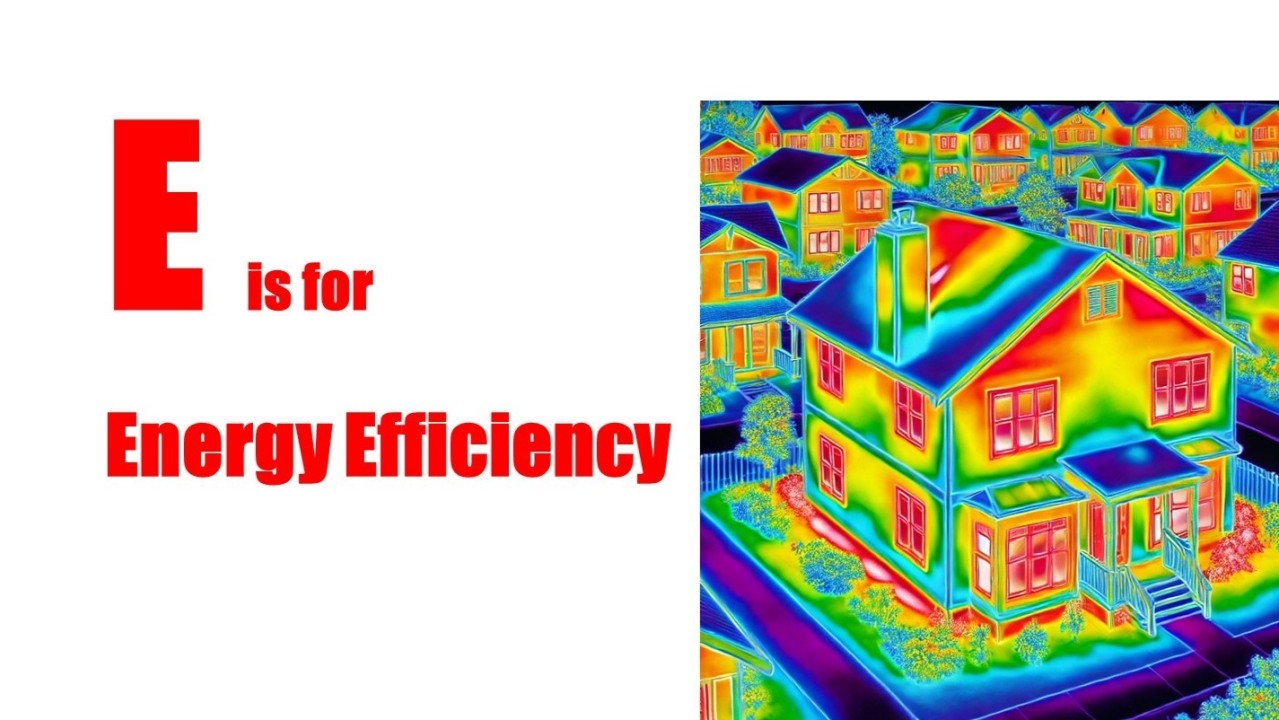
"The lowest carbon, cheapest and most secure form of energy is the energy we don't use".
I can't take credit for this quote. Various people have used a version of this and I think its origin may be from International Energy Agency (IEA)'s Fatih Birol (happy to be corrected!).
This is such an obvious statement and yet as society, energy efficiency is typically the 'ugly duckling' of the energy transition. It's difficult for political leaders to don high-viz jackets and stand next to examples of energy efficiency in practice, rather than offshore wind farms or giant solar plants.
Energy efficiency finally received a much needed boost when it was recognised at COP28 in Dubai, with a target of doubling energy efficiency by 2030.
As the only professional body that charters energy managers, I'm very proud of the Energy Institute's work on multiple aspects of energy efficiency. So I will shamelessly promote some of our members' and colleagues' excellent work!
I'm going to talk about four dimensions of energy efficiency - of course there are others
1. Building efficiency
2. Behavioural change
3. Process efficiency
4. Electrification
Building efficiency
According to the International Energy Agency (IEA), buildings account for around 30% of final energy consumption - most of which is from heating and cooling. In a world where energy was (relatively) cheap and climate change was not a priority, most developed countries have constructed incredibly inefficient buildings - be that homes, offices, schools or hospitals. There are, of course exceptions. Scandinavia is well known for having far better insulated buildings. And German firm PassivHaus makes pre-fabrication buildings which typically do not require active heating or cooling.
So why aren't countries like the UK moving faster on improving standards? On new builds, one of the biggest challenge is the misaligned incentives between those who face the capital costs and those who bear the operating costs. And on existing stock, the challenge is often the disruption, regulation and costs of making changes. Virtually any building can be made more efficient. RIBA show same great examples: Energy efficiency - Design in the making. The question is whether it makes economic sense to the owner and tenant and knowing what changes give the biggest benefits. Some solutions, such as LED light bulbs, can repay their capital cost in a matter of months. Other solutions, such as retrofit insulation or triple glazing might take years to cover their cost (let alone cost of capital).
The role of Energy Institute Chartered Energy Managers is critical in helping businesses and consumers make the right choices.
• Read more from one of the Energy Institute's Members: Shining a Spotlight on Energy People: Tom Kelly MEI Chartered Energy Manager
• And the Energy Institute's broad range of energy management training: Energy Management and Energy Efficiency
Process energy
One thing engineers love doing is optimising efficiency and performance, so over decades many high-intensity forms of energy consumption have dramatically improved fuel efficiency. The 1970s oil crisis led to far tighter standards for fuel economy of cars. For example in the US, the CAFE (Corporate average fuel economy) standards have moved from under 20 mpg in the late 1970s to over 40 mpg today. Similarly, just in the last two decades or so the average fuel per seat km in an airline has fallen by around one third. For example a short haul journey on a late 1990s Boeing 737 would have used around 3 litres / seat 100 km versus around 2 litres for a 737-Max today. The same would be true comparing an Airbus A321 Neo against an A319.
In power generation the efficiency of gas-fired power plants varies dramatically. An open cycle gas turbine (which vents its exhaust gases) might only achieve around 30% efficiency. Add in a combined cycle (CCGT), which recovers additional energy from high grade waste heat and that figure reaches around 50%. And last year, a Siemens SGT5-9000HL gas turbine reached a record 64.2%. The good news is that as we continue to replace cars, aeroplanes and gas turbines they get ever more efficient. The bad news is that the relative gains get smaller as we get closer to the limits of thermodynamics. And of course, if overall demand increases faster than efficiency then absolute emissions still rise.
The bigger future opportunity potentially lies in far better use of reusing low-grade waste heat. At a local level, this could be taking waste heat from a data centre to heat a public swimming pool. Tiny data centre used to heat public swimming pool - BBC News. On a much larger scale this could involve capturing industrial and other waste heat to create a heat network to supply heat to homes and businesses. The Association for Decentralised Energy have produced this helpful summary: Heat networks
Behavioural change
As any parent (or at least some dads of a certain age) knows, addressing basic behavioural change is one of the largest challenges of energy efficiency. Most of us are guilty of leaving lights on, sometime heating an office with the windows wide open, or keeping a car idling at the school pick up. For much of recent history, until recent price hikes, energy has been relatively cheap and it's hard to measure or sense how much is wasted by each of these actions - unlike the noise of water flowing from a running tap.
Behavioural change is a key aspect of driving energy efficiency. On one level it is very easy to see how simple lifestyle choices can make a big difference. On another level, it's very hard to change human habits. In the previous edition (D is for Digitalisation), I described some of the tools that provide consumers with insights on how much energy they are using, as well as pricing incentives them encourage them to either reduce or shift demand. What works for one individual may not work for another. For some cost is the biggest incentive, for others it might be reducing their carbon footprint, or social cohesion (such as public requests to reduce demand during periods of potential black out in California). And for some groups, gamifying becomes the incentive to change behaviours.
There is also a role for education and simple tools that help educate. The Energy Institute's Energy Aware online training tool is a freely available tool to help consumers understand how consumers can reduce energy. We've also made bespoke versions of the software for businesses such as John Lewis & Partners and Keltbray engage their staff in reducing energy costs and emissions.
One potential double-edged sword to energy efficiency is Jevon's Paradox. In the mid 19th Century, English economist William Jevons observed that as efficiency in coal production and combustion improved, coal found far more uses. A a modern-day example is around LED bulbs. When I grew up most rooms in my parents' home had one incandescent ceiling light, with perhaps a 60 or 100 Watt bulb. My kitchen has no fewer than 16 (very efficient) LED bulbs, but if they're all on at once I'm using the same power as my parents' 1980s kitchen. Similarly, homes are typically much warmer today than before central heating (How warm is your home? - BBC News)
Electrification - the superpower of the transition
And finally, I'd love to cover a topic which arguably is the most powerful driver of energy efficiency and a 'superpower' of the energy transition - electrification. It almost merited a letter to itself but I'll cover this topic in far more detail in some further letters down the alphabet!
Throughout most of history we have burnt fuels for most of our energy. First wood, then whale oil, coal, oil and gas. We have used whatever was abundant and cheap. These fuels also brought the benefits of relatively easy transportation, storage and high energy density, both by volume and mass. This is why these fuels have and continue to dominate the global energy mix (according to the Energy Institute Statistical Review of World Energy, in 2023 coal, oil and gas accounted for 81.5% of primary energy). Whilst these fuels were (relatively) cheap, abundant, and, easy to transport and store, they have one major weakness - they are incredibly inefficient. I already covered the efficiency of gas-fired generations. Move to coal-fired generation and the numbers are even lower.
And in transport the numbers get far worse. An internal combustion engine (ICE) car is around 20-30% efficient, with 70-80% of the input energy wasted (largely as heat). By contrast, an electric vehicle (EV) is around 85-90% efficient, so needs around one-third to a quarter of the energy input. Even if an EV's electricity is 100% from gas-fired power, it's still about twice as efficient as an ICE. Similarly heat pumps (which I covered in A is for Air Source Heat Pump) typically produces 3 or 4 units of heat for each unit of electricity, compared with a gas boiler which produces around 0.8-0.9 per unit of equivalent gas input.
Most of us have got used to measuring energy on the input side (the Energy Institute Statistical Review of World Energy is also guilty of using primary energy as its measure). What ultimately matters is 'useful' energy. How much energy do I need to move a car from A to B, or create 100 lumens of light or a warm home. As we electrify more and more end uses, from cars to industrial heating, we ultimately can do more with less input energy. That, in my view, is why the energy efficiency from electrification will be one of the super powers of the energy transition. Watch this space for more on this topic in future letters!
Further reading:
As always, a few more articles for those who wish to dig deeper:
Save it: Why tackling energy efficiency in European buildings is a priority
Pathway to net zero: UK government and local authorities align for greener homes
Investing in energy efficiency is key to meeting climate goals
US publishes plan to decarbonise buildings sector
Driven by high energy bills, Europe’s efficiency measures also have a lasting effect
