
The A to Z of the Energy Transition: D is for Digitalisation
I am sure some of you might have expected that D would be for Data Centres (and AI). This was certainly the topic of 2024, but it's also been well covered by others, including these excellent articles from the Energy Institute's New Energy World magazine: Rising data demand puts pressure on US energy grid and by Michael Liebreich: Generative AI – The Power and the Glory.
And I know some of you will be screaming at me, 'No!! D is for Demand Side' at your phone or laptop screens. Fear not, because I'll not only be covering some key demand side aspects in both this edition and also when we get to E....
But for D I want to focus on the tremendous impact that digital technologies are going to have on energy. I'll do this through these three lenses:
1) Digital tools to engage energy consumers
2) Digital's role in balancing the grid
3) Digital solutions to solve complex energy challenges
Digital tools to engage energy consumers
Imagine going to your local supermarket for a weekly shop. Everything is normal, except that nothing is marked with a price. Maybe you couldn't cope and would leave for a rival store. Maybe you'd still do your shopping as normal, and so long as the amount at the till was roughly the same as usual you'd be ok. But what if it was 50% more than normal? Would you try to put back the items you guessed were too expensive?
What a crazy and ridiculous scenario! And yet that is how most of us consume electricity (and gas) in our homes. Most of us receive a monthly or quarterly bill, which may or may not be accurate, without any idea on the usage split. How much does the washing machine use - more or less than the tumble drier or fridge? What difference does it make having the home heated one degree cooler, or running the washing machine on a cooler cycle? Who knows?!
Most consumers, beyond noticing that it costs more to heat a home in winter than summer, have little idea of the split of the energy they use or how they could save energy. What about businesses? A large corporate, particularly if they employ a Chartered Energy Manager, should have a reasonable idea. For energy-intense industries, like steel manufacturing, energy represents a very large component of costs. A supermarket chain, running thousands of chiller and freezer units, should also have a decent idea. But even then, is the data flow live or is it summarised monthly or quarterly? As for smaller businesses, there is likely far less understanding of how energy is consumed.
Digital technologies which can disaggregate energy use, provide real-time feedback and optimise use, have an important role in engaging consumers and businesses alike in saving energy. Companies such as Voltaware have developed technology which detects the signature profile of individual appliances, to give a household insight on consumption and to act upon it.
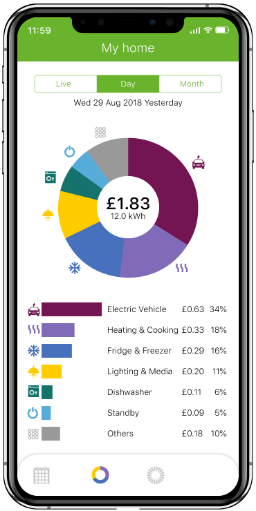
Source: Voltaware, example of household electricity split
Similar technologies have also been developed for commercial and industrial users. Grid Edge has developed AI-driven solutions for large commercial users, such as shopping centres, to optimise their energy use against cost and/or the carbon intensity of the grid. For example, pre-cooling a building when electricity is both cheaper and lower carbon. You can read more here: Flexibility Update 2024.
This also brings up the concept of digital's role in balancing the grid, through demand-side management, the second topic.
Digital's role in balancing the grid
Arguably the way most electric grid systems operate has hardly changed in a century (no offence intended to grid operators). Grids are managed centrally in massive control rooms, anticipating peaks in demand down to the split second. This great video from National Grid shows a particularly British problem - anticipating the demand increase as the nation puts on its kettles for a cup of tea after the 'doof doofs' at the climax of an episode of Eastenders (a UK soap opera).
So traditionally, supply has had to follow demand, often with expensive and high carbon sources of generation meeting those peaks. And at the other extreme, curtailing excess energy during periods of low demand. For the typical consumer, this happens without any impact on cost, so there's no incentive to change consumption behaviours. This is a bit like an airline charging the same fares all year round, even at peak holiday times, but grounding some of the fleet of planes and crew in the quieter months.
What if price signals were used to change or shift demand? It might prevent the need to bring on expensive and high-carbon generation, like gas peaking plants. Demand-side management already plays an important role in managing commercial and industrial uses. Back to those supermarkets: shutting off power to chiller units for half an hour won't affect food quality, but can help shift demand to cheaper and lower-carbon periods AND earn income for the business.
Such solutions are now finding their ways into homes, exposing consumers to variably pricing or customised offers for EVs or heat pumps, such as as Octopus Energy's Agile and Cosy tariffs and OVO's Charge Anytime EV tariff. These allow consumers to optimise their consumption and even automatically control high-consumption appliances, like heat pumps and EVs. On occasion power prices sometimes go negative (typically due to an excess of wind and solar). If this happens, consumers on some tariffs actually get paid for using electricity - often charging their cars and/or home batteries. All of this helps energy suppliers better manage and predict demand, helping to reduce dependence on expensive and high-carbon forms of generation. At larger scales, this form of demand-side response can have a meaningful impact on a country's generation at peak times, particularly as the number of EVs and heat pumps rises. Temporarily switching off home chargers to 150,000 EVs (about 15% of the UK's fleet) could instantly reduce demand by 1GW. Of course the consumer should always have the choice if they want this to happen, but the incentives paid to consumers would likely motivate many to sign up.
Take this another step, with consumers, or prosumers, who also have the capacity to supply into the grid, be that through rooftop solar, home batteries or EVs with V2G (vehicle to grid), and it's possible to create new peer-to-peer energy markets. One home with excess solar could feed into a neighbour's EV during periods of peak prices, earning income for the first home, and providing lower prices for the second home. Such solutions also reduce dependency on transmission and distribution systems. Some instances even allow housing developments to proceed where otherwise there would be insufficient grid capacity.. Community projects, combining solar, battery storage and peer-to-peer digital solutions, have the potential to reduce the size of required grid connections by optimising demand and supply across a whole community. Companies including Sitigrid (with which I have a declared interest) are developing business models to achieve just this.
Pretty much all the technologies we need to build such solutions exists today. The challenges tend to be around regulation, consumer acceptance and integration of different IoT (Internet of Things) technologies, i.e., having smart controls on key consumer appliances. But it's not hard to imagine a world a few years from now where consumers allow their energy provider to control key the use of key devices to optimise cost and CO2 impact, whilst always allowing the consumer to override should they so choose.
And these solutions can help reduce the investment required in infrastructure. At International Energy Week 2025 Octopus Energy's CEO Greg Jackson quoted a potential £10bn saving on grid infrastructure from use of smart technology.
Digital solutions to solve complex energy challenges
Finally, digital technologies have a major role to play in solving complex challenges across the entire energy system. For example, digital twins are increasingly being used to help better design and operate everything from wind farms, to carbon capture projects (Using Carbon Capture and Storage Digital Twins for Net Zero Strategies - NVIDIA Technical Blog), to the design of offshore oil and gas platforms. Silicon Valley data giant Palantir Technologies has been working with bp since 2014 on managing massive and disparate data sets to better inform decision making.
Amongst many other digital solutions, ExxonMobil is working with IBM on the use of quantum computing to accelerate development of new chemicals for carbon capture technologies.
And on grid technologies, National Grid Partners has invested in a broad range of disruptive digital companies, including AiDASH, which combines satellite imagery with AI to better manage vegetation surrounding grid infrastructure, as well as Carbon Lighthouse, which helps reduce building emissions.
These are just a few snapshots, there are many, many other such examples of energy companies investing in disruptive start-ups. And it feels that we are just at the very early stages of seeing the impact of digital technologies on energy business models.
Going back to the start of this article, for the moment I am sure the conversation will continue to be about the quantum of energy demand for data centres and AI. But for me, I am far more excited about the opportunity that digital technologies will bring to bear across the entire energy system - helping lower emissions, making energy accessible, secure and more affordable. Ultimately making life better for individual consumers and society as a whole.
And we are just at the start of this revolution. The next few decades are going to be completely different from the past century.
Some further reading below:
All the following come from the Energy Institute's New Energy World magazine, courtesy of Will Dalrymple. Please feel free to add other articles in the comments!
AI's expanding role in the energy transition
How digital twin technology is a game changer for offshore wind
UK’s first smart substation installed, and biggest energy supplier revealed
Modelling will make the green transition smoother and quicker
How digitalisation is a catalyst for decarbonisation downstream
Powering up data-driven decarbonisation and flexibility
Power demand forecasting using space-based data
