
The A to Z of the Energy Transition: C is for Carbon Capture
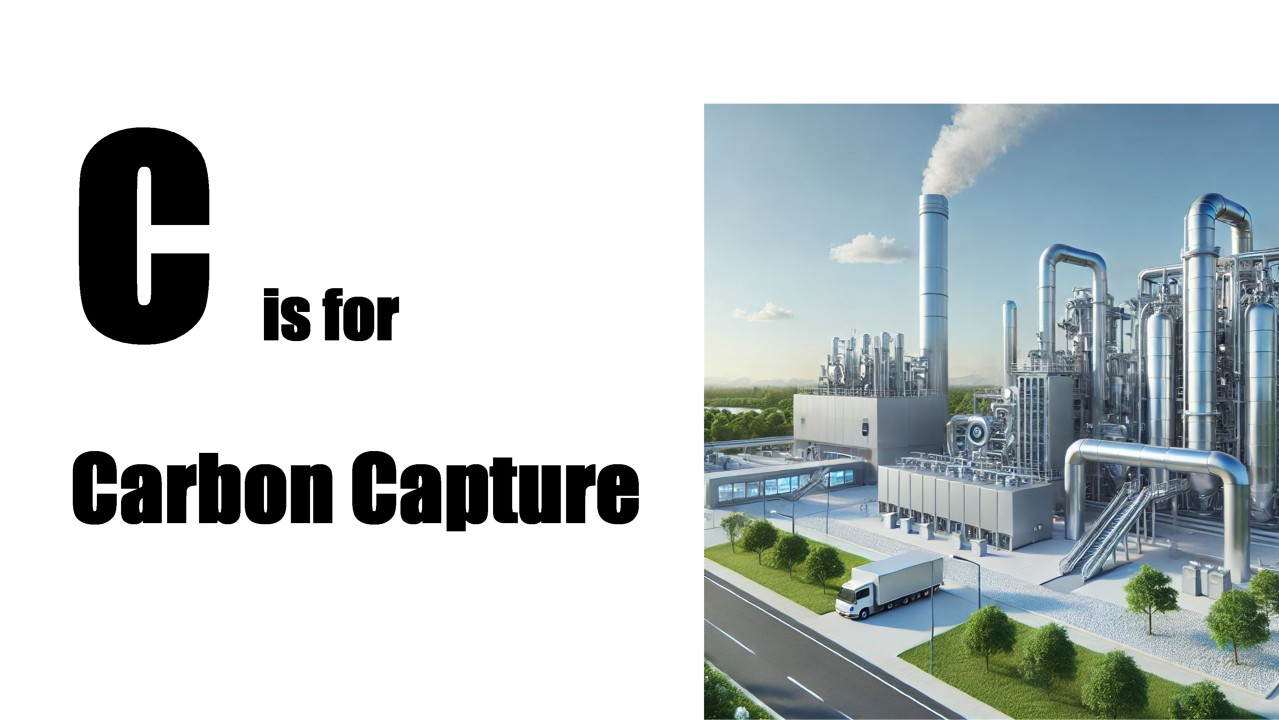
Another letter. Another very broad topic.
Note: I know the 2 on CO2 should be a subscript but LinkedIn won't let me format it like this!
As always, the views expressed are my own. Before we jump into various technologies, it's worth getting back to basics on what removing carbon means and the difference between capture and carbon removal.
Broadly speaking:
• Carbon capture (use and storage) - takes CO2 out of hydrocarbons either pre or post combustion. This technology can reduce the CO2 impact but unless the source of the hydrocarbon is from biogenic materials it cannot create 'negative' emissions or absolute zero emissions.
• Carbon removal technologies - refers to technologies that take CO2 directly out of the atmosphere. So long as the CO2 removed is greater than the CO2 used in powering the solution this can create negative emissions.
Carbon capture (utilisation and storage)
CO2 injection for EOR (Enhanced Oil Recovery)
The genesis to CCUS goes back many decades, when injection of CO2 was found to be an effective way of improving recovery rates from oil fields. The first commercial examples of EOR date to the 1970s in Texas. CO2 was sourced from underground reservoirs or captured from industrial plants to be injected into oil reservoirs where, due to its miscibility, it mixed with oil to reduce viscosity and improve flow rates. This has become a well tested means of improving oil production. Of course, none of this is was about reducing CO2 emissions to the atmosphere (and quite the opposite when move oil was produced).
Early CCS projects
In the 1990s CCS evolved to address production of gas reservoirs with naturally high CO2 levels. The CO2 would otherwise would have been separated and vented to the atmosphere. These projects were typically driven by government mandates that restricted the levels at which CO2 could be vented from gas production. Equinor's Sleipner gas field in Norway was the first in Europe to develop this technology. Other projects followed including In Salah Gas in Algeria (a project I worked on in the early 2000s), and Gorgon LNG in Australia. All of these projects use amine, a solvent, which absorbs CO2 in a process column. The CO2 is then boiled off from the amine, compressed into liquid CO2 and transported via pipeline to be injected into a separate reservoir for geological storage (or potentially for EOR if there is a suitable oil field close by).
Whilst this chemical process is well proven and relatively straight forward, the track record of these projects has been mixed. At In Salah Gas, around 4 millions tonnes of CO2 was successfully captured, until the decision was made in 2011 to stop injecting due to concerns over the geological integrity of the rock containing the CO2. However, there has been no recorded leakage of CO2 from this project. 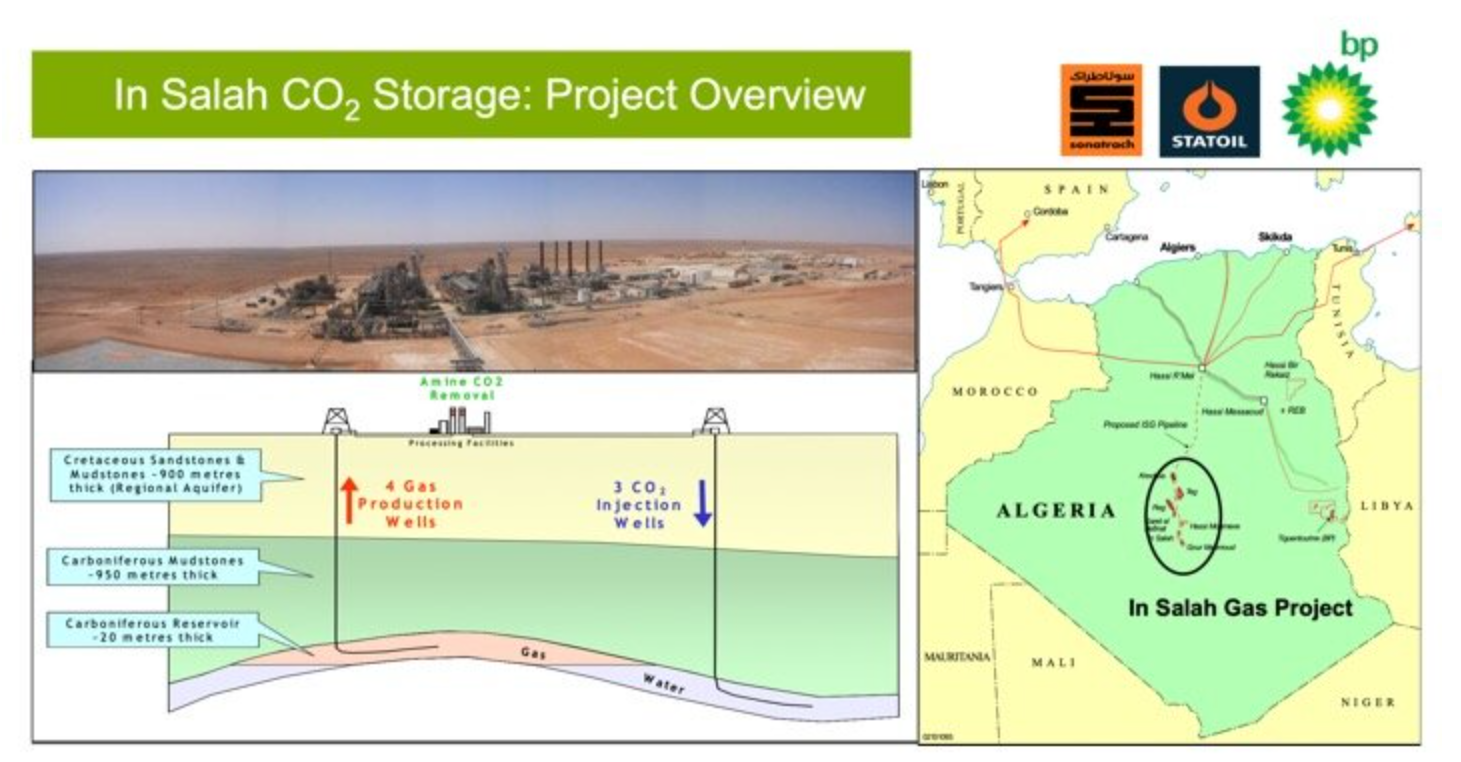 Schematic showing In Salah Gas CCS - source Sonatrach (I remember this actual slide from my time on the project between 2000-2004, when I worked at Tegentour)
The above projects were focused on removing naturally occurring CO2 contained within natural gas at the point of production but not the vast majority of CO2 emissions at the point of combustion. A tonne of methane when combusted produces around 2.75 tonnes of CO2, so far greater than the volume injected in these projects.
Integrated CCUS projects
More recently CCUS focus has evolved to addressing the emissions from the use of the natural gas, not just naturally occurring CO2. The CO2 can either be captured pre combustion (through separating gas (CH4) into blue hydrogen (H2) and CO2 which is captured and stored. Or by capturing the CO2 post combustion, from the exhaust stream. The merits of pre vs post combustion depend on a number of factors, such as whether there are multiple uses for blue hydrogen, such as for refining or fertiliser production, versus not having to make changes to the combustion processes (such as modifying gas turbines to accept hydrogen) but then having to collect CO2 from multiple sources.
One of the earliest attempts of this was the Peterhead Power station in Aberdeenshire. The original intention was to separate CO2 from North Sea gas, to create a pre-combustion blue hydrogen-fired power station, and to return the CO2 back offshore to inject it into, what was bp's, Miller field. The fundamental challenge with such a project was creating the appropriate regulatory structures and incentives to make commercial sense. In this instance, these criteria were not met and the project didn't go ahead.
Now, nearly 20 years on, SSE plc is seeking consent to develop a post-combustion CCS project at the same site: Peterhead Carbon Capture Power Station - SSE Thermal
Industrial clusters
The next and current evolution of CCUS is around creating industrial clusters, which allow CO2 from multiple industrial sites to be aggregated, centrally compressed and injected into depleted oil and gas fields. In late 2021 the UK Government approved two 'track 1' such clusters: NZT (Net Zero Teesside) - The UK’s first decarbonised industrial cluster and HyNet North West. These projects are supported by multiple local industrial users. The UK Government announced a commitment of nearly £22bn to support these projects in 2024.
The partners of NZT reached final investment decision (FID) in December 2024, with the project due to commence construction this year and come online in 2028. The cluster includes Net Zero Teesside Power - a combined cycle gas turbine 742 MW power station incorporating carbon capture. This will power the equivalent of over 1 millions UK homes. The CO2 from NZT will be gathered, compressed and then piped 145 km offshore to an aquifer 1000m under the seabed with initial capacity to store up to an 4 million tonnes of CO2 per year.
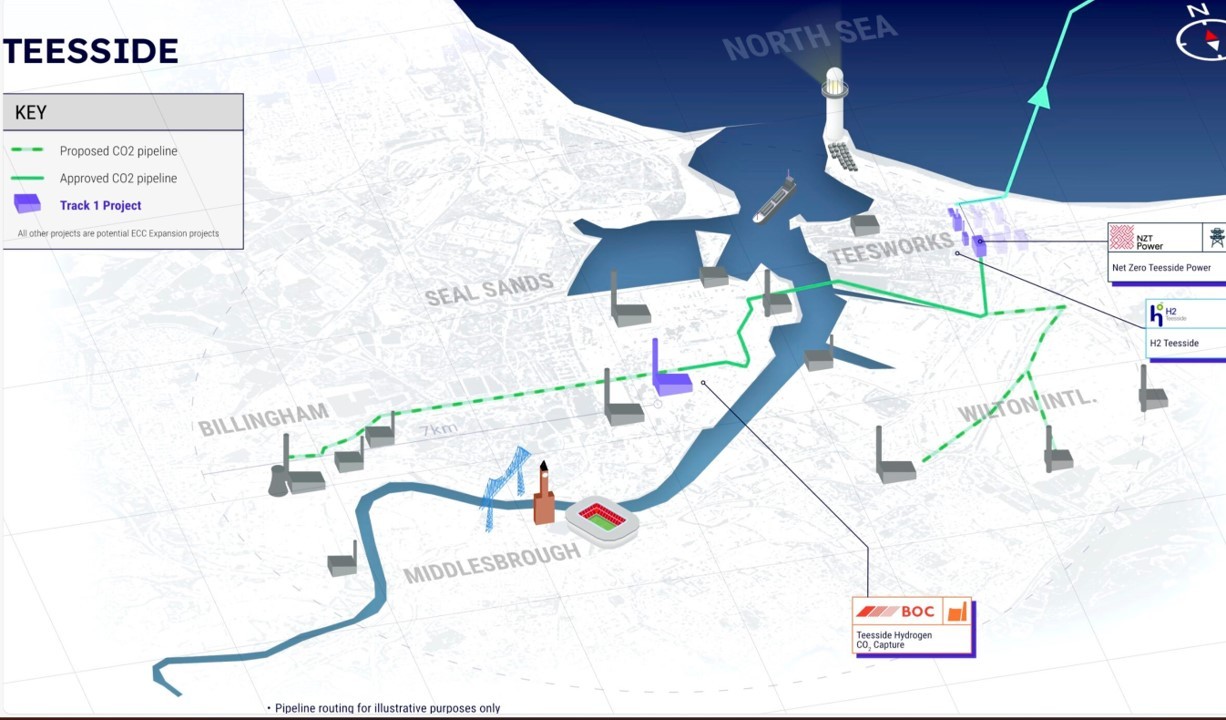 Schematic of Net Zero Teesside. Source: Net Zero Teesside website
Some see CCUS as an expensive solution, which prolongs our dependency on fossil fuels, however, groups such as the UK's independent's Climate Change Committee have supported the development of such projects, with former CEO Chris Stark stating, "The UK’s transition to a low-carbon economy rests partly on this essential CCUS technology, so it’s imperative that plans for its deployment are robust, and rolled out in time.”
Projects like NZT and Hynet North West are going to be critical in demonstrating that industrial decarbonisation is scalable, commercial and technically successfully. A lot of eyes will be watching these projects when they come online towards the end of this decade. The Energy Institute is working with industry, regulators and academia to help develop technical good practice in how such projects are designed and operated safely. Below are a few links to recent technical publications (which are freely available to the Energy Institute's technical partners:
EI 3545 Repurposing and Design Guide for Carbon Dioxide Pipelines
EI 3553 Hazard analysis for onshore and offshore carbon capture installations and pipelines
CCUS is also attracting new and innovation companies and technologies to the sector. Storegga and Azuli CCS are independent CCUS developers, seeking to create new business models, which don't depend on big oil and gas players leading projects. Carbon Clean have developed novel solvents combined with a modular 'Lego plug and play' approach to hardware to dramatically reduce the size and cost of carbon capture process plant.
Carbon removal technologies
The above CCUS projects have been focused on either removing naturally occurring CO2 from gas or eliminating the combustion emissions from industrial use of natural gas. As such they play a major role in reducing emissions. A well designed and operated CCUS project might get to 90%+ CO2 reduction but it doesn't get us to absolute zero, or negative emissions. We are never going to get to zero CO2 emissions through technologies like renewables and CCUS alone and at some point will need negative emissions (i.e., taking CO2 out of the atmosphere) to get us to net zero.
BECCs (Bio Energy with Carbon Capture)
I mentioned BECCs in the previous edition - B is for Bioenergy - LinkedIn. BECCs effectively uses the same type of CCUS solution as above but on projects where the feedstock is biogenic rather than fossil. So for example, if carbon capture is applied to the post-combustion exhaust of a biomass boiler the CO2 is taken out of the atmosphere as the feedstock was grown but rather than being returned to the atmosphere it's captured and stored this (done properly with sustainable feedstock) results in negative emissions.
Drax Group brought on the first European example of such a project in 2018. Europe’s first bioenergy carbon capture and storage pilot now underway - Drax Global
Direct air capture (DAC)
DAC, as the name suggests, takes CO2 directly out of the atmosphere. The good news is that climate change is agnostic to where on the planet CO2 is removed, so DAC can be done where it is more economical and practical. The technology typically relies on large fans that suck a vast quantity of air through a capture process, using liquid or solid solvents, to remove atmospheric levels of CO2. The CO2 is then separated out from the solvent and either utilised or stored, similar to the process on CCUS. As such a DAC project could be integrated with a CCUS project to optimise on the compression and storage infrastructure.
However, the relatively very low concentrations of atmospheric CO2 (around 420 parts per million) which is two of three orders of magnitude less concentrated that the CO2 content in CCUS projects creates two challenges.
First a LOT of power is required to run the process. This means that DAC is still a very expensive technology. There's a wide range of estimates on cost, with figures of up to $600 per tonne CO2 equivalent often quoted. The International Energy Agency (IEA) show a range with around $250/tonne CO2e at the midpoint. This compares to figures for conventional CCUS of well under $100/tonne CO2, depending on the specific use case. Is carbon capture too expensive? – Analysis - IEA Clearly these costs will decline as technology evolves and if we have an abundance of cheap, low-carbon energy in the future.
The second challenge is that not only does the electricity powering DAC need to be zero carbon but it needs to be demonstrated that is fully additive and couldn't be used for other decarbonising other uses. For example, there would be little point in building a DAC plant next to a town or data centre, but then having to continue to rely on gas-fired generation for the town because the DAC plant used all the available low-carbon electrons. Of course, real life is rarely as black and white as this example, but it's important to consider the merit order of how low-carbon electrons are best utilised and the overall system impact.
DAC is one of the few scalable solutions reliant on relatively proven technology, capable of producing negative emissions. As such there would seem to be merit in developing the technology to bring down costs, ready for a point later this century when focus increases on negative emissions and we hopefully have an abundant supply of low-cost, zero-carbon electrons from renewables, nuclear or even a breakthrough in fusion.
DAC is gaining investment dollars Several commercial plants are in operation or planned in Europe and the US such as this Climeworks project in Iceland Orca is Climeworks' new large-scale carbon dioxide removal plant
Nature-based solutions
The last area, which I'll cover briefly as it's a huge topic in its own right, is nature-based solutions. At its most basic this is often characterised as planting trees . However, there are a whole selection of other solutions under this topic, including avoided deforestation, producing and storing biochar and technologies such as enhanced rock weathering (which works by using crushed rocks to absorbed CO2). There are also companies developing solutions for trapping CO2 in concrete.
I'm not going to go in to further details on these areas, as each could justify their own article and they are not directly related to energy. The key points I will make is that it's critical that such solutions have integrity and trust on how they are measured, assured and marketed to ensure there isn't double counting of CO2 saved (e.g., one person paying for a tree, another person paying for the same tree not to be cut down!). It's also important to consider the timeline over which the CO2 is removed from the atmosphere. A tree is a phenomenal sink for CO2 but it takes decades for it to work. So planting a tree against a flight to New York today is not going to make the timely difference we need to happen. And if the same tree is cut down and burnt all that CO2 is released back into the atmosphere. For those of you wish to learn more, here's a good resource on these topics: Nature-based Solutions - IUCN
Further reading:
Here's a few more links for reading around all these topics, courtesy of Will Dalrymple at the Energy Institute's #NewEnergyWorld magazine.
Markets:
Installed global CCS capacity on track to double once projects being constructed begin operations
CCUS to play key role in Australia’s decarbonisation
CCUS – a $196bn investment opportunity
Projects:
CCS offers Humber a new pipeline to prosperity
On the horizon: Norwegian CCUS vision soon to be made real
First Teesside CCS contracts reached financial close in December
New Indonesian President signs off $7bn gas project while reaffirming 2050 net zero target
Features: analysis:
Carbon capture is ‘a decarbonisation pipe dream’, says IEEFA
CCUS: a silver bullet for a clean energy future?
Why CCUS must accelerate to meet global climate goals
Features: other
How to overcome the technical challenges of carbon capture projects
